Showing posts with label coast guard. Show all posts

Sunday, July 12, 2026

The Lie We Tell Children

There are two phrases nearly every child hears while growing up. They are spoken by loving parents, encouraging teachers, patient coaches, and well-meaning grandparents. "Just do your best." "Just try hard." Those words are intended to build confidence, reduce fear of failure, and encourage perseverance. For children, they are wise counsel. The problem is not that they are wrong. The problem is that they become incomplete. If we never replace those childhood lessons with the realities of professional life, they can become the very beliefs that limit our success as adults.

I learned that lesson in one unforgettable conversation during Coast Guard Radioman School. Looking back, I have come to believe the greatest lesson the Coast Guard taught me had nothing to do with Morse code, radio theory, electronics, or typing. It was a lesson about standards, accountability, and the difference between effort and performance. That lesson has shaped every leadership position I have held since, from law enforcement to community organizations. It began when a chief challenged two of the most common messages we tell children.

Radioman School was a demanding five-month course designed to prepare Coast Guardsmen to operate and maintain the communications systems that connected ships, aircraft, and shore stations. We learned electronics, antenna theory, radio maintenance, message handling, and military communications procedures. We also had to master two practical skills that measured our readiness: typing at thirty-five words per minute and accurately copying Morse code at eighteen words per minute.

By the fourth month, I was falling behind. I was studying hard, staying late, and putting in the effort, but effort alone was not closing the gap. One afternoon I was called into the chief's office.

He looked at me across his desk and asked two simple questions.

"Are you doing your best?"

"Yes, Chief."

"Are you trying hard?"

"Yes, Chief."

He leaned back and said something I have never forgotten.

"That's your problem."

I remember being stunned. Those were exactly the answers I thought he wanted to hear.

He continued.

"You're not paid to do your best. You're paid to meet our standards. It's our best that's required. It's our standard that saves lives, not yours. You don't decide what the standard is. We do."

Then he addressed my second answer.

"And you don't get paid to try. You get paid to do. You're an adult now."

At the time, his words felt harsh. Today, I recognize them as one of the greatest leadership lessons I have ever received.

As children, we are encouraged to do our best because children are still discovering what they are capable of becoming. Comparing one child's progress to another often discourages learning. Praising sincere effort builds confidence and resilience. Those are important developmental goals, and decades of educational and psychological research support encouraging persistence while skills are being developed. Carol Dweck's work on growth mindset, for example, demonstrates that effort plays an important role in learning because it helps people embrace challenge and continue improving rather than giving up at the first sign of difficulty.

But somewhere between childhood and adulthood, the measuring stick changes.

Professionals do not establish the standards by which they are evaluated. Organizations do. The Coast Guard establishes qualification standards for radiomen. Hospitals establish standards for surgeons and nurses. Airlines establish standards for pilots. Police academies establish standards for recruits. Engineers, firefighters, air traffic controllers, and nuclear technicians all work within objective performance requirements that exist because other people's safety depends upon consistent competence.

The standard is not personal. It is professional.

That realization changes everything.

The second lesson was equally important. Children are praised for trying because trying is the beginning of learning. Adults, however, eventually enter professions where effort alone no longer defines success. No patient asks whether the surgeon tried hard. No airline passenger hopes the pilot gives his best effort. No Coast Guard crew drifting in heavy seas wants to hear that the radioman sincerely tried to transmit the distress message.

Trying matters because it leads to competence.

Competence is what ultimately matters.

This is not an argument against effort. It is an argument for understanding effort's proper place. Effort is the investment. Competence is the return. High-reliability organizations cannot afford to confuse the two because standards exist to reduce uncertainty when the consequences of failure are significant. As surgeon Atul Gawande observed in The Checklist Manifesto, consistent adherence to proven standards often prevents mistakes that individual talent alone cannot overcome.

For leaders, this distinction has practical implications.

The first transition is replacing personal benchmarks with professional standards. Instead of asking, "Did I do my best?" leaders ask, "Did I meet the standard?" Feelings become secondary to measurable performance. The standard remains constant regardless of how difficult the day may have been.

The second transition is learning to receive feedback as information rather than criticism. My chief was not attacking my character. He was identifying the gap between my current performance and the Coast Guard's expectations. Effective professionals separate their identity from their performance. One can always improve the other.

The third transition is understanding that competence is built through disciplined practice rather than motivation alone. Research on expertise by Anders Ericsson demonstrated that exceptional performers do not become exceptional because they simply try harder. They improve through deliberate, structured practice focused on correcting weaknesses until high performance becomes routine rather than occasional.

The fourth transition is measuring success by reliability. Leadership is ultimately about trust, and trust is built when others know they can depend upon consistent performance. James Kouzes and Barry Posner have long argued that credibility is the foundation of leadership. Credibility grows when leaders repeatedly meet expectations, especially when circumstances are difficult.

The chief who spoke those words decades ago probably never imagined that I would still be thinking about that conversation many years later. I honestly don't remember how quickly I eventually mastered Morse code or how long it took me to reach the required typing speed. Those were valuable skills, and the Coast Guard rightly expected me to master them. But they were not the most important lesson I carried away from Radioman School.

The lesson that stayed with me was that professionalism begins the moment we stop measuring ourselves by effort and start measuring ourselves against standards. Children are encouraged to try hard and do their best because they are still discovering what they can become. Professionals accept something far more demanding. They do not define excellence. They pursue it. In every profession where lives, livelihoods, or trust are at stake, people are not protected by good intentions. They are protected by competence. The Coast Guard was never interested in my personal definition of "my best." It expected me to meet its standard. That lesson has guided every leadership role I have held ever since.

References

  1. Dweck, Carol S. Mindset: The New Psychology of Success. Updated ed. Random House, 2016.

  2. Ericsson, K. Anders, and Robert Pool. Peak: Secrets from the New Science of Expertise. Houghton Mifflin Harcourt, 2016.

  3. Gawande, Atul. The Checklist Manifesto: How to Get Things Right. Metropolitan Books, 2009.

  4. Kouzes, James M., and Barry Z. Posner. The Leadership Challenge. 7th ed. Wiley, 2023.

  5. U.S. Coast Guard. Competency Management System Manual, COMDTINST M5300.2 (current edition).

About the Author

Raymond D. Foster is a retired police officer, university educator, leadership consultant, and author. Drawing on decades of experience in the U.S. Coast Guard, law enforcement, higher education, and civic leadership, he writes about leadership, decision-making, organizational culture, and personal growth. He is the author of Leadership: Texas Hold'em Style, Chasing the Surge: 10,000 Rides in the American Night, and The Temple Within, where he combines real-world experience with practical leadership lessons for today's readers.

Friday, July 15, 2011

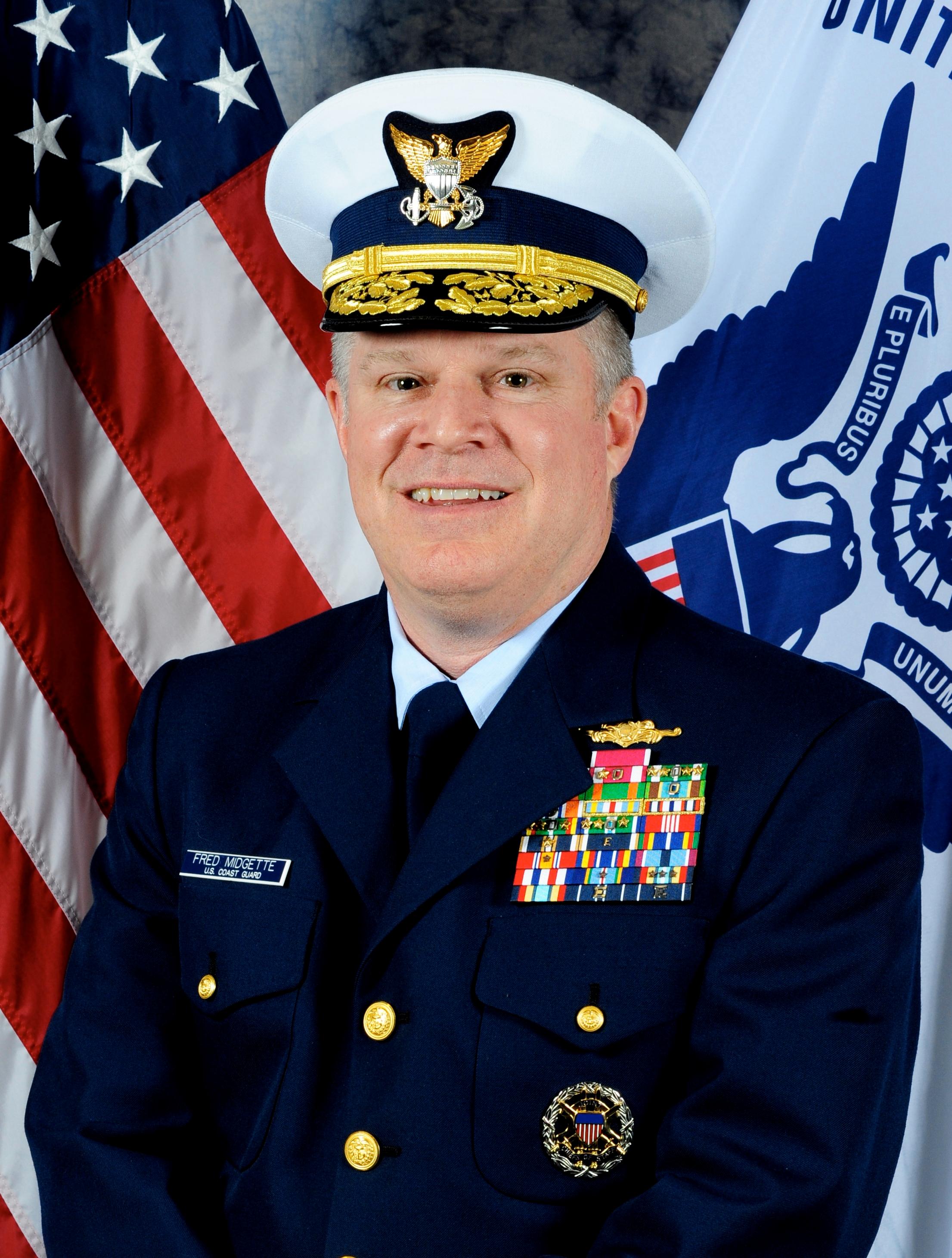
Military Advisor Rear Admiral Fred M. Midgette

Rear Admiral Midgette assumed the duties of Military Advisor to the Secretary of Homeland Security in May 2011. In this assignment, his primary responsibility is to provide counsel and support to the Secretary in affairs relating to the coordination and execution of policy and operations between the Department of Homeland Security and the Department of Defense.

His prior assignment was as Chief of Staff of the Ninth Coast Guard District where he served as the principal deputy for all Coast Guard policy and operations on the Great Lakes.

He was the Sector Commander and Captain of the Port of Sector Detroit from 2008 – 2010, and has served in a number of joint and liaison positions including tours at the Pentagon, on the Joint Staff (J-7, The Joint Force Interoperability Directorate); as a liaison officer to the US Customs Service in Washington, DC; and as the Coast Guard’s liaison officer to US Northern Command in Colorado Springs, CO.  He has also served in shore assignments as the Executive Assistant to the Chief of Operations at Coast Guard Headquarters in Washington DC; as a Company Officer at the Coast Guard Academy in New London, CT; and on the Training Infrastructure Study and Streamlining Implementation Team at Coast Guard Headquarters.

He is a Coast Guard Cutterman, and a qualified Surface Warfare Officer having served afloat on both coasts and the Great Lakes sailing in: USCGC TANEY (Portsmouth, VA); USS FIFE (San Diego, CA); USCGC POINT LEDGE (Fort Bragg, CA); USCGC POINT WINSLOW (Eureka & Morro Bay, CA); USCGC KATMAI BAY (Sault Ste. Marie, MI); USCGC HARRIET LANE (Portsmouth, VA); USCGC FORWARD (Portsmouth, VA); and on America’s Tall Ship - the Coast Guard Barque EAGLE.

Rear Admiral Midgette is a native of Virginia Beach, VA and he holds a Bachelor of Science in Civil Engineering (Coast Guard Academy – 1982), a Masters of Science in Management (Rensselaer Polytechnic Institute – 1991), and a Master of Arts in National Security and Strategic Studies (Naval War College – 1997).

Saturday, February 05, 2011

Shipmate of the Week – LT Bill McKinstry

Posted by: LTJG Stephanie Young

In this era of rapid change, we all too often ignore history and define ourselves in terms of where we are headed and not where we have come from. But history matters, and Lt. Bill McKinstry is doing his part to make sure that the U.S. Coast Guard remembers its heritage.

McKinstry’s journey into history began by chance when the son of a Coast Guard veteran stopped by the quarterdeck of Sector Delaware Bay in late 2007 with his father’s scrapbook. His father had recently passed and the son wanted to share the photos.

McKinstry met with the son and talked about the service as they reminisced over old memories. Amongst the photo collection, there were some of a Coast Guard basketball team. It was upon scanning the photos that McKinstry noticed the players’ names listed on the back of a photo. As he glanced over the names, one name, Emlen Tunnell, looked familiar.

 “Familiar” was an understatement, as this was the Emlen Tunnel – the Pro Football Hall of Famer and record breaker. Guided by this recognizable name, McKinstry set out to research what Tunnell did during his service with the Coast Guard. Over the next four years, McKinstry purchased books, poured through historic documents and collected every bit of information he could find about this Coast Guardsman turned football player.

What he found was not just trivia, but evidence of a man, who in his short time in service, was a true Coast Guard leader and hero.

It was already known that Tunnell saved a life during combat while aboard the USS Etamin, but during McKinstry’s research it was discovered that he was also recommended for a Silver Lifesaving Medal for another heroic act where he saved a shipmate from drowning in the freezing waters of Newfoundland, something not even mentioned in Tunnell’s own memoir.

“I think the thing that surprised me the most was how humble he was about it,” said McKinstry. “You aren’t going to find anything about his heroism on the Internet. In his autobiography he actually mentions it more in passing than really focusing on it.”

Through his time in the Coast Guard, McKinstry has learned that one of the keys to being a good leader is recognizing your people. Tunnell would be no exception.

“When I see someone deserving who needs recognition I go out of my way to see it happen,” said McKinstry. “In this case, when talking of the prejudices of the time and when the original award recommendation was submitted [about three weeks before he was discharged], I felt that he needed to be recognized.”

McKinstry, working with Coast Guard historians and the Medals and Awards Program, has resubmitted Tunnell’s recommendation for the Silver Lifesaving Medal and hopes to one day present it to a member of Tunnell’s family.

The history of the Coast Guard and its people plays a role in shaping its values and beliefs, but in our fast paced lives it is not uncommon to underestimate the power of this history. McKinstry and his efforts reminds us that to define the Coast Guard by what we have in store for the service, pales in comparison against the service’s rich past.

History: Emlen Tunnell, an unsung hero

Posted by: LTJG Stephanie Young
Written by Dr. David Rosen, Coast Guard Historian

As we head into Super Bowl weekend, it seems only fitting that this month’s history post shares the story of Emlen Tunnell. When most people hear the name Emlen Tunnell, they think of the star athlete and the first black member of the New York football Giants, joining the team in 1948. Nicknamed “Mr. Defense,” the former halfback switched to defense for the Giants, setting records for interceptions and punt returns in 1952 and 1953 – both records that remained unbroken until his death in 1975, with his interception total of 79 still falling only two short of all time interception leader Paul Krause.

Tunnell would end his storied career with the Green Bay Packers in 1961 and, in 1967, become the first African American inducted into the Pro Football Hall of Fame. As fans across America marveled over Mr. Defense’s on-field leadership and heroics, his accomplishments were hardly surprising to those who witnessed his valor and heroism as a Coast Guardsman during World War II.

Tunnell served honorably from 1943-46 as a steward’s mate aboard several ships – twice cited for exceptional acts of heroism.

On April 27, 1944, the Coast Guard-manned cargo ship USS Etamin was unloading 6000 tons of explosives and gasoline while at anchor at Aitape Harbor, Papua New Guinea. Without warning, Etamin was attacked by Japanese aircraft and a torpedo blew a hole 27 feet by 27 feet in the ship’s starboard side.

With the shell plating and shaft alley of Etamin ruptured, gasoline sprayed over the after part of the ship, creating a dangerous situation for all aboard. It was Coast Guard Steward’s Mate Emlen Lewis Tunnel who came to the aid of Mechanics Mate First Class Fred Shaver, who was on fire, pulling him to safety and severely burning his own hands in the process.

Tunnell, who was known to speak in football metaphors, later recalled the sinking ship as, “a small, tough fullback, without much speed, pounding forward every minute of the game.”

On March 17, 1946, Tunnell was nominated for the Silver Lifesaving Medal for once again saving the life of a fellow shipmate.

His shipmate, Alfred Givens, fell off the dock of the Coast Guard Cutter Tampa. Without regard to his own safety, Tunnell jumped into the 32-degree seas and rescued Givens. Tunnell saved his drowning shipmate, and despite being in the water for only fifteen minutes, suffered exposure and shock.

In recognition of Tunnell’s heroic actions, the commanding officer of Tampa, Cmdr. Ralph Jenkins, nominated Tunnell for the Silver Lifesaving Medal. A momentous occasion considering African Americans were not customarily awarded medals at that time in our history. He would receive a posthumous Combat Action Ribbon and is currently being considered for a Silver Lifesaving Medal.

Friday, January 28, 2011

Shipmate of the Week – Dr. John Oliver

Posted by: LTJG Stephanie Young

A majestic lighthouse on the Great Lakes. A sustainable fish hatchery along the Atlantic coast. A marine sanctuary off the Olympic Peninsula. An industrious port in the country’s heartland.

America’s coastal environments are all vastly different, yet they remain connected in ways that influence everyone. With the ocean touching every aspect of our lives, preserving the coastal environment is of the highest importance.  The Coast Guard’s Dr. John T. Oliver has become intimately involved in ensuring that our nation preserves these vital ecosystems.

Developing a strategy for the ocean, our coasts and the Great Lakes became a national priority when President Obama announced America’s first national ocean policy in June 2009.

As a result, Dr. Oliver, Senior Ocean Policy Advisor, now represents the Coast Guard and Department of Homeland Security on the country’s first National Ocean Council. Oliver, leading a team of subject matter experts, is tasked with developing and implementing plans for the ocean, our coast and the Great Lakes in which a growing number of uses – economy, energy, security, cultural, recreational – are expanding at a rate that challenges our ability to effectively plan and manage ecosystems.

Appreciating the fact that local decisions regarding personal, recreational, or commercial use of a waterfront are often made with little regard to how they can impact hundreds of miles of coastline and the nearby marine environment, Oliver knows that we cannot continue down this path.

“This new approach to ocean management will promote the Coast Guard’s safety, security, and stewardship missions,” said Oliver. “Having the information so that you really know what is going on in the ocean and along our coasts, and making management decisions based on what is best for the entire ecosystem, is critical to restoring the health and maximizing the economic productivity and enjoyment of our bountiful and beautiful maritime domain.”

Addressing the impacts these competing demands can have on a marine ecosystem is known as Coastal and Marine Spatial Planning and Oliver is looked to as one of the nation’s leading experts on effective CMSP.

Developing a CMSP policy is no easy task, and one of the biggest hurdles is ensuring every stakeholder has a voice. To consider all of the key issues, the Task Force has reached out to stakeholders representing the maritime shipping industry, commercial fishing interests, the recreational fishing, boating, and yachting community, coastal tourism boards, port and waterway experts and specialists in national and homeland security.

“Dr. Oliver’s remarkable efforts have ensured that the Coast Guard will play a leadership role in the National Ocean Council and in the Coastal and Marine Spatial Planning process,” said Rear Adm. Brian Salerno, Deputy Commandant for Operations. “We could not have achieved all that we have without his extraordinary work.”

Whether you work in a port complex or sail on a freshwater lake, the oceans and coastal areas all play a key role in the lives of every American. While each ecosystem has connections with others that are both complex and intricate, Dr. Oliver and his colleagues are at the forefront of change aimed at preserving our oceans, coasts and Great Lakes for future generations.

Friday, January 21, 2011

Shipmate of the Week – The crew of CG6022

Posted by: LTJG Stephanie Young

Uncontrollable variables, such as weather, location, time of day or aging response boats and aircraft, presents every Coast Guard search and rescue crew with unique challenges. But, few cases present the confluence of obstacles the aircrew of CG6022 faced when they launched from Andros Island, Bahamas, last month.

Arriving on scene, 47 nautical miles offshore, with the 50-foot sailing vessel Arktur taking on water, Lt. George Menze and Lt. George Cottrell, the aircraft commander and copilot, had to position their helicopter in sustained winds at 35 knots. Using night vision goggles, the aircrew could see the vessel as it pitched and rolled violently in the seas and wind. The sailing vessel was a two-masted ketch, with no open areas for hoisting, and its swaying masts were a clear hazard for the helicopter.

The howling winds and heavy seas had forced the three sailors aboard below decks, making them initially unaware of the 6022’s presence. Menze and Cottrell placed the helicopter in a 70-foot hover and used the searchlight to alert the sailors who eventually moved above decks.

The decision was made to deploy the rescue swimmer, and Menze focused on adjusting the helicopter’s altitude with Cottrell calling out incoming swells. Petty Officer 2nd Class Sara Faulkner had requalified as a rescue swimmer days before and this would be her first case being deployed since Hurricane Katrina followed by a tour as a recruiter. She recalls the moments after she was lowered into the water.

“The boat I was trying to swim to was moving fast,” said Faulkner. “I seriously had my doubts if I would catch it and as soon as they lowered me down I realized just how fast the boat was being pushed away from me by the winds and the helicopter rotor wash. “

The flight mechanic for the 6022, Petty Officer 2nd Class James Nelson, was also battling the breaking swells as he assisted Faulkner from above, and was drawing upon what he learned from Advanced Helicopter Rescue School, a training that is held where the high seas thrash the Northwest coastline in Oregon. Without his focus, the basket and swimmer could easily become lost in the foamy seas.

“I’ve done a lot of medevacs in the past, in all different situations,” said Nelson. “But this is the first time I’ve actually used the swimmer and put them in the water with their fins on.”

Faulkner powered through the 20-foot swells and reached the boat, attempting to grab low hanging ropes in order to talk with the sailors. When a large swell pitched the stern of the vessel into the air, Faulkner disappeared under the stern, but maneuvered out of the way before the stern came crashing back down.

On Faulkner’s command, the sailors, one by one, took the plunge into the Atlantic.

Nelson raised the first survivor, as he contended with the breaking waves that periodically buried both Faulkner and the sailor in white foam. As the first sailor was hoisted, the winds and seas caused the vessel to drift 100 yards from Faulkner, and a rescue sling was used by Nelson to reposition Faulkner, and the second sailor was successfully hoisted.

With only one sailor remaining, it was decided to recover the remaining sailor in a sling deployment instead of a rescue basket to avoid burning out the hoist. After the ready signal was given, Faulkner and the last sailor were hooked together and hoisted into the helicopter’s cabin.

The 6022 aircrew battled nightmarish conditions and personal challenges as they rescued all three sailors aboard Arktur. But every success an aircrew has pales in comparison to the gratitude felt by those whose loved ones are now safe.

“When I heard Lynn’s voice from Nassau, a wave of relief and gratitude flowed over me. Relieved to know he was okay and gratitude that the Coast Guard was there and able to rescue them,” said Barbara Deedler, spouse of Lynn Deedler, one of the sailors rescued. “Because of them, our family has much to be thankful for as we start a new year.”

Friday, January 14, 2011

Shipmate of the Week – CDR James Robertson

Posted by: LTJG Stephanie Young

Coast Guard men and women deployed to Iraq are taking part in missions they will draw upon for the rest of their careers. For Cmdr. James Robertson, assigned to United States Forces-Iraq with the Port Advisory Coordinating Element, that life-changing mission just may be taking place outside of his official duties as he works to support the Umm Qasr Women’s Center, empowering local Iraqi women to make a difference in their communities.

As officer-in-charge of PACE, Robertson works with the government of Iraq, port authority and maritime industry to develop and implement a port security program that meets international standards. His four-member PACE team is constantly traveling to engage and mentor area leaders on port security and to assess Iraq’s seaports – vital to both the security and economy of this oil rich nation.

It was on a trip to Umm Qasr to survey community facilities for potential capital improvement projects where Robertson was first introduced to the Umm Qasr Women’s Center.

The Women’s Center is devoted to empowering women in the local community. At the center, women learn basic seamstress and accounting skills that prepare them to own and operate home businesses. The center also provides classrooms where their children can begin a basic education and a get reprieve from the streets of Umm Qasr.

“During my visit to the Center, I saw a great need for even basic supplies at the center,” said Robertson. “I was moved to action by the squalid conditions I encountered there.”

Motivated both by what these women were trying to accomplish and that they were struggling to succeed in the face of financial and societal hurdles, Robertson seized the moment. Through Operation Mailbox, Robertson reached back to his hometown in New Jersey and the Alaska community where his previous unit was based for help.

Combining his passion and relationships with Iraqi community leaders, Robertson’s efforts paid off, in the form of school supplies, toys, sewing materials and personal hygiene items shipped from friends and family back home to support the women and children of Umm Qasr.

Through his actions, Robertson demonstrated both compassion and a keen sense of foreign policy smarts.

“If the Iraqi people can understand that we truly care for their wellbeing, their safety and prosperity, it will open doors of mutual trust.”

Friday, December 31, 2010

Guardians of 2010: December

Written by: Christopher Lagan

Each week we honor members of the Coast Guard family as “Guardian of the Week” for their leadership, devotion to duty, and contributions to our service. As we close out 2010, we’re looking back over the year to celebrate the contributions of the Guardians of 2010. Today, we revisit those recognized in December 2010.

LT James O’Mara – December 3, 2010

We’ve spent a lot of time during this Compass series talking about teamwork. So, it seems only fitting that we would kick-off December with the story of Lt. James O’Mara and the crew of the Coast Guard Cutter Farallon.

As Commanding Officer of Farallon, O’Mara has the responsibility to create a positive culture aboard his unit. At no time was that teamwork more evident than during a seven-day period where his crew stopped two drug smuggling ventures and one migrant smuggling attempt.

SN Kristin Reger – December 10, 2010

When you think of a Coastie putting his or her life on the line by jumping into the water to save a life, the first image that pops into your mind is likely a highly trained rescue swimmer. The search and rescue case that resulted in Seaman Kristin Reger being awarded the Coast Guard Medal will forever change that image.

Swimming out to an overturned sailboat Seaman Kristin Reger was not thinking of anything except the man trapped beneath the hull. With a polypropylene line connecting her to the Coast Guard Station Golden Gate 47-foot Motor Lifeboat, her training kicked in as she battled four-foot seas to reach the boat.

BM2 Joseph D’Amico – December 17, 2010

Command of a Coast Guard Cutter is one of the highest honors a seagoing military officer will ever hold. The responsibility of the officer of the deck (OOD) is to stand in for the ship’s captain during your watch. This position is reserved for officers and the most senior of enlisted personnel. That is what makes the qualification of Petty Officer 2nd Class Joseph D’Amico as OOD for the 270-foot Coast Guard Cutter Bear just one more highlight of an outstanding cutterman’s Coast Guard career.

When D’Amico is not standing watch on the bridge, he is one of Bear’s “go to” smallboat coxswains. D’Amico proved to be an instrumental asset during the cutter’s recent patrol where the crew was involved with five separate go-fast pursuits within a two-week period.

Coast Guard Santa and elves – December 24, 2010

The Coast Guard is a unique military service because we live within the very communities where we operate. That makes for lasting relationships and traditions that continue on long after the change of the watch at a Coast Guard unit. One such tradition is the Santa to the Villages program.

The program, now in its 37th year, takes volunteers from the Spouse’s Association of Kodiak and teams them up with [Coast Guard Cutter] Spar and an air crew from Air Station Kodiak to deliver holiday cheer to seven remote villages on Kodiak Island: Ahkiok, Larsen Bay, Karluk, Ouzinkie, Port Lions and Old Harbor.

AST3 Christopher Austin – December 31, 2010

Think your first day on the job was tough? For one of the Coast Guard’s newest rescue swimmers, his first day involved a rescue off the always dangerous coast of Washington state and the realization that you simply cannot save every victim. Petty Officer Christopher Austin was standing his first watch after graduating from “A” school when the call came in that two fishermen were in the water after their boat capsized.

“Everything that was going through my head was all the training that I’ve had in the past two years and especially throughout A-school,” recalls Austin. “As soon as I grabbed him [the fisherman], I put my arms up underneath him, and a wave hit me with so much force my goggles came up off my face. I kept working, kept trying to get this guy’s head above the water.”

Congratulations to all of the Guardians of 2010!

Guardian of the Week – AST3 Christopher Austin

Written by: LTJG Stephanie Young
With contributions from PA3 Kelly Parker.

The Coast Guard trains its people to be Always Ready and that training is never more important than on your first search and rescue case. On Petty Officer 3rd Class Christopher Austin’s first duty day as a Coast Guard rescue swimmer there was no time for uncertainty – a vessel had capsized in the Pacific northwest’s icy waters and he was being called upon to save lives.

Austin and an aircrew from Air Station Astoria were airborne when the report came in that a fishing vessel had capsized with two people aboard.

With only two miles of visibility, the aircrew diverted to the opening of Willapa Bay, Wash. and spotted a debris field. The aircraft commander, Lt. Benjamin Schluckebier, turned the helicopter around to follow the debris field. That’s when despite the fact neither fisherman was wearing a life jacket, the aircraft flight mechanic, Petty Officer 2nd Class Andre Altavilla, noticed a person in the water.

“The boater rapidly deteriorated from swimming, to barely keeping his head out of the water, to being under for 10 seconds at a time when getting hit by waves, to face down in the water and not moving,” recalls Schluckebier.

Austin was lowered into the 45-degree water, and although he was on his first case on his first day of duty, the agitated waters showed no mercy as he attempted to reach the now unresponsive fisherman.

“Everything that was going through my head was all the training that I’ve had in the past two years and especially throughout A-school,” recalls Austin. “As soon as I grabbed him, I put my arms up underneath him, and a wave hit me with so much force my goggles came up off my face. I kept working, kept trying to get this guy’s head above the water.”

Austin was pummeled by waves, but with support from Altavilla who was paying out his cable, he was able to shelter the fisherman. After the ready signal was given, Austin and the unconscious fisherman were hoisted into the helicopter.

Once safely inside the cabin, Altavilla and Austin administered CPR and the man began to breathe once again.

Although Austin was the one deployed in the water, he credits the rescue to the teamwork of his aircrew.

“I didn’t see this guy – the flight mechanic found him. I didn’t jump out of the plane – I got hoisted down by the decision of the pilot. I didn’t do CPR by myself – I was gassed after getting hit by all those waves,” said Austin. “My biggest thing is that you’re not the hero, you’re not the one saving people. It’s the guys that you’re with who have your back and you have to have their back just as much to get the job done.”

Despite saving a life his first day on the job, Austin learned a hard lesson; after an extensive six-hour search for the second fisherman, by both air and surface rescue crews, the search was suspended.

“We couldn’t get the other guy and I was kind of beating myself up about that. We did everything we could to get there,” said Austin.

Thinking about the lost fisherman, it was Austin’s family who put things in perspective for the young rescue swimmer.

“When I got off the phone with my dad on Christmas my fiancé said to me, ‘You know that he [the fisherman] gets to be at home with his family for Christmas.’”

Thursday, December 30, 2010

Guardians of 2010: November

Written by: Christopher Lagan

Each week we honor members of the Coast Guard family as “Guardian of the Week” for their leadership, devotion to duty, and contributions to our service. As we close out 2010, we’re looking back over the year to celebrate the contributions of the Guardians of 2010. Today, we revisit those recognized in November 2010.

Auxiliary Commodore Nicholas Kerigan – November 5, 2010

We kicked off the month of November by looking back at the two-years Commodore Nicholas Kerigan led the Coast Guard Auxiliary. Kerigan oversaw a complete reorganization of the 31,000-plus volunteer force while supporting major operations including the Haiti earthquake response, Operation Arctic Crossroads, and the Deepwater Horizon Response.

Kerigan, a member of the Auxiliary since 1992, was busy leading from the top, but showed his constant dedication to all Auxiliary members by his wealth of qualifications. Kerigan maintained qualifications as coxswain, air observer, vessel examiner, instructor and a qualification examiner.

Ed Kruska – November 12, 2010

A recently retired Chief Warrant Officer, Ed Kruska spent a good portion of his career promoting our service and the memories of those who have worn the uniform. While serving as the editor of Coast Guard Reservist magazine, Kruska published a story about Coast Guard monuments across the United States urging Coast Guardsmen nationwide to pay their dues to those who served before them. That story was the inspiration for Coast Guard Flags Across America.

“It is an honor and privilege to commemorate the service of Coast Guard veterans that guarded our coasts in peace and defended our Nation in war,” said [Adm. Bob] Papp, adding, “With Flags Across America, Ed Kruska has established in our service a powerful way for us to observe these manners of our profession with dignity and admiration.”

Christine Greiner – November 19, 2010

As we headed into Thanksgiving Week, we found ourselves expressing our gratitude to Mrs. Christine Greiner, Ombudsman for the Coast Guard Cutter Jarvis homeported in Honolulu, Hawaii. As ombudsman, Greiner is quite literally the key link between the crew of the 378-foot cutter and the family members left behind when the ship deploys.

“Ombudsmen volunteer their time and talents to create a community for unit family members left behind,” said Master Chief Petty Officer of the Coast Guard Michael Leavitt praising the efforts of all Ombudsmen. “Their hard work and dedication allows members of the Coast Guard to continue to focus on mission execution while being secure in the knowledge that things are running smoothly on the home front.”

LTJG Steven Lewis – November 26, 2010

The international response to the Carnival Splendor, the cruise ship left adrift more than 100 miles off the coast of California by an engine fire, made for great television news and some interesting challenges for Coast Guard responders, including one ensign whose training and ingenuity were put to the test by this unique rescue mission.

Landing a U.S. Navy SH-60 Seahawk helicopter on a Panamanian-flagged cruise ship presented unique challenges. Adding to the complexities of the operation was the need to communicate with multiple entities including the aircraft commander, supply chief and on scene commander. Lewis used his training and experience to assure the team that it could be done safely – besides, the Lido deck was at least twice the size of the VERTREP area on Morgenthau.

Congratulations to all of the Guardians of 2010! Come back tomorrow as we wrap up our tribute series with the Guardians of the Week for December 2010.

Wednesday, December 29, 2010

Guardians of 2010: October

Written by: Christopher Lagan

Each week we honor members of the Coast Guard family as “Guardian of the Week” for their leadership, devotion to duty, and contributions to our service. As we close out 2010, we’re looking back over the year to celebrate the contributions of the Guardians of 2010. Today, we revisit those recognized in October 2010.

AST1 Salvador Carire – October 1, 2010

Coast Guard rescue swimmers are trained to put themselves in harms way to save others, but the decision to continue to search for a survivor in a hopeless situation putting your own life at risk is what sets them apart from the rest of us. Petty Officer 1st Class Salvadore Carire proved that he was one of the elite as he put himself in harms way to pull a survivor from an overturned life raft in heavy seas and frigid waters nearly 40-miles off the coast of New Jersey.

Carire ripped into the raft that cocooned a barely conscious, hypothermic survivor. With the 280-pound man in tow, Carire signaled the 6559 to lower the rescue basket. Carire stayed in the water, experiencing early stages of hypothermia himself, as the aircrew raised the fisherman safely into the aircraft and returned to hoist him. Once inside the aircraft, Carire used his medical training to treat the survivor and keep him conscious.

The crew of the Amy Julie – October 8, 2010

We continued October with another amazing search and rescue case conducted by members of the Coast Guard Auxiliary. There is perhaps no better example of the role that auxiliarists play in support of Coast Guard operations than the rescue performed by the crew of the Amy Julie when a surprise squall struck Buzzards Bay.

The crew of the Amy Julie decided that it was best to start checking on popular fishing and recreational boating areas. The crew’s plan to check the popular areas paid off, when the Amy Julie approached a fishing area and spotted a 17-foot center console boat submerged to the gunnels.

Click here to read more about how the local knowledge of an auxiliary crew saved three lives.

Mr. David Condino – October 15, 2010

The international maritime community has long struggled with balancing the realities of long ocean journeys with the need to keep our oceans free of trash. Over the past several years, David Condino has made a name for himself as a champion of marine environmental protection by helping the International Maritime Organization reform rules for dumping at sea.

A Master Mariner, Condino holds a license of unlimited tonnage and has sailed the world’s oceans thus creating a deep connection to all things maritime. Through his global travels, he has gained a firsthand perspective of how garbage thrown overboard affects the maritime environment.

BM1 John Costabile – October 22, 2010

The Coast Guard’s small size and unique mission set lends itself to the development of leaders across the service. Our next two Guardians of the Week are such men.

Aboard the 270-foot Coast Guard Cutter Campbell, Petty Officer 1st Class John Costabile established himself as the kind of leader that inspires the crew from the commanding officer all the way down to the non-rates. He’s also one of the most successful drug interdiction boat drivers in the Coast Guard.

While his shipmates admire him, drug runners are dismayed by his tenacity and deep seated drive for operational excellence. In 2009 Costabile led 10 high-speed, close-quarter pursuits with go-fast boats, often requiring speeds in excess of 40-knots with challenging weather and in unfamiliar and poorly-charted waters.

CDR Matthew Meilstrup – October 29, 2010

Coast Guard officers are expected to be good leaders and rely on the trust and respect of those who they command to accomplish the service’s many missions. As the recipient of the Captain David H. Jarvis Inspirational Leadership Award, Cmdr. Matthew Meilstrup, executive officer of the Coast Guard Cutter Jarvis, demonstrated the kind of leadership that inspired an entire crew.

“Cmdr. Meilstrup had tremendous respect for all of us,” said Lt. Heather Bacon-Shone, operations officer on Jarvis. “I think that’s because he first saw us as people, and secondly as shipmates, and only thirdly as cooks, chiefs, junior officers, boatswains’ mates, or firemen.”

Congratulations to all of the Guardians of 2010! Come back tomorrow as we pay tribute to the Guardians of the Week for November 2010.

Tuesday, December 28, 2010

Guardians of 2010: September

Written by: Christopher Lagan

Each week we honor members of the Coast Guard family as “Guardian of the Week” for their leadership, devotion to duty, and contributions to our service. As we close out 2010, we’re looking back over the year to celebrate the contributions of the Guardians of 2010. Today, we revisit those recognized in September 2010.

LT Wayne Miller – September 2, 2010

Lt. Wayne Miller (USCGR) was just one of thousands of Coast Guard men and women to find themselves deployed to the Gulf of Mexico to protect the coastline in the aftermath of the Deepwater Horizon oil spill. Miller was on his way to a planning meeting when fate – and his Coast Guard training, found him plunging into a burning car to save another. In true hero style, Miller lauded the victim for his courage.

“He inspired me for the rest of my life because he pushed through that pain, that incredible pain.”

AST2 Lake Downham – September 10, 2010

As a Coast Guard rescue swimmer, Petty Officer 2nd Class Lake Downham spends a lot of time in the water saving lives. So, it should come as no surprise he would choose to give of his own time to help children with disabilities build confidence on the water.

“My favorite thing to teach them is surfing,” says Downham. “A lot of the kids are afraid of the water and don’t want to get in, and then by the end of the day they don’t want to leave the water.”

ME2 Nick Antis – September 17, 2010

Teamwork is a critical part of any law enforcement operation. For Petty Officer 2nd Class Nick Antis and his partner, Ryder, teamwork could mean the difference between life and death. As one of the Coast Guard’s explosives detection canine teams, a lot is riding on their ability to work together in defense of our security.

As a deployable asset, Antis and Ryder are capable of operating in a variety of geographic locations and environments with the ability to work ashore or aboard vessels, and deploy from helicopters by vertical delivery. Recently, canine teams from [Marine Safety and Security Team] Los Angeles/Long Beach provided support to the commissioning of the [Coast Guard Cutter] Waesche, the Super Bowl, and the Rose Bowl, among other events.

AMT3 Kelly Dunn – September 24, 2010

Every successful search and rescue case performed by a Coast Guard air station begins well before the command center receives a distress call and launches a helicopter or plane. Were it not for the flight mechanics that keep our aircraft mission ready, many a distress call would go unanswered. The Coast Guard has found a one-of-a-kind aviation maintenance technician in Petty Officer 3rd Class Kelly Dunn.

One of the Coast Guard’s newest AMTs is Petty Officer Third Class Kelly Dunn. Graduates from AMT “A” school have proven their understanding of complex aviation systems. Dunn, however, demonstrated her mastery on the subject further, as she graduated as class leader, honor graduate and with the academic achievement award.

Congratulations to all of the Guardians of 2010! Come back tomorrow as we pay tribute to the Guardians of the Week for October 2010.

Monday, December 27, 2010

Guardians of 2010: August

Written by: Christopher Lagan

Each week Coast Guard Compass honors members of the Coast Guard family as “Guardian of the Week” for their leadership, devotion to duty, and contributions to our service. As we close out 2010, we’re looking back over the year to celebrate the contributions of the Guardians of 2010. Today, we revisit those recognized in August 2010.

LTjg Amanda Bazinet – August 9, 2010

Anyone who has spent time at sea knows that there are those who thrive above decks and those with a unique ability to keep the engines running. It is a rare occurrence for a military officer to succeed in both worlds given the demands of life afloat, but that is exactly what Lt. j.g. Bazinet did aboard the Coast Guard Cutter Escanaba.

One of the steepest learning curves for a junior officer on a cutter is watch qualification, usually as an engineer or deck watch. The former entails learning how to operate all of the mechanical components on board the ship, the latter places the officer in charge of the operation of the entire ship. Most officers qualify in one or the other. Bazinet did both.

“It’s not unheard of,” said Cdr. Edward Westfall, Escanaba commanding officer, “but it’s not very common either.”

The crew of CG 6565 – August 13, 2010

The designation “Guardian of the Week” is usually reserved for an individual, but sometimes a crew – in this case an aircrew, demonstrate such exceptional teamwork that we honor them all. The crew of Coast Guard rescue helicopter 6565 turned what could have been a fatal case into your typical Coast Guard rescue.

Many (search and rescue) responders describe trying to find a person in the water at altitude like trying to find a needle in a haystack. And the conditions that day made the case even tougher – no position certainty and no information on what, or who was in the water if anything or anyone. All the crew knew was they needed to go check it out.

The persistence, dedication and excellent local area knowledge of the aircrew paid off. In only the first pass, flying at 200 feet or about 20 stories up, Lt. (Jeff) Jacobs inexplicably, spotted a woman in the water.

SKC Dave Curran – August 20, 2010

A shared love of fly fishing led Chief Petty Officer Curran to honor the loss of his brother Carl, an Army National Guardsman killed by an IED in Iraq, by sharing the sport that meant so much to both of them with disabled veterans returning from war.

“My time spent sharing my hobby is like giving the trip I had promised to my brother,” said Curran.

Curran worked tirelessly with Project Healing Waters to plan a weeklong fly-fishing excursion on the American River near Kodiak for five disabled military members and veterans.

Master Chief Steven Hearn – August 27, 2010

Over the past 220 years, the Coast Guard has evolved to face new threats to our national security and advanced the way the world protects people at sea. Yet, in all that time, one thing hasn’t changed – Coast Guardsmen have always battled the sea to save lives and prove their mettle. With more than 22 years spent serving at sea, Master Chief Hearn is considered the Coast Guard’s Silver Ancient Mariner, a designation held only by the “saltiest” of those to go to sea as a member of our service.

The Gold and Silver Ancient Mariner awards, established in 1978, honor the officer and enlisted member who personifies the dedication and professionalism associated with long service at sea and has the distinction of being called a “Cutterman” longer than any other active duty member.

Congratulations to all of the Guardians of 2010! Come back tomorrow as we pay tribute to the Guardians of the Week for September 2010.

Guardians of 2010: July

Written by: Christopher Lagan

Each week Coast Guard Compass honors members of the Coast Guard family as “Guardian of the Week” for their leadership, devotion to duty, and contributions to our service. As we close out 2010, we’re looking back over the year to celebrate the contributions of the Guardians of 2010. Today, we revisit those recognized in July 2010.

Jim Smith – July 2, 2010

Civilians play a vital role in Coast Guard operations. As the maintenance mechanic leader for Air Station Atlantic City, Jim Smith has proven just how valuable the civilian workforce can be to mission excellence.

“The most stand-out element of Jim is he’s really a jack of all trades,” said Capt. Paul Ratte, commanding officer of the air station. “He’s integrated at all levels. Countless times he’s asked the right questions and has averted potential disasters.”

LT David Ratner – July 9, 2010

Over the past several years, piracy on the high seas has become a major threat to the international maritime community. The piracy crisis in places like the Gulf of Aden showcased the unique capabilities of the Coast Guard as both a military and law enforcement organization. Lt. Ratner leads one of the Coast Guard teams responding to this emerging global threat.

Ratner led his team on 11 high-risk boardings in the Gulf of Aiden and he and his team directly stopped at least three pirate attacks on unarmed merchants protecting billions of dollars in cargo aboard the many ships that transit the area said Lt. Cdr. Michael Fredie, executive officer of Tactical Law Enforcement Team South.

MK3 Carlos Camacho – July 16, 2010

As the smallest of our nation’s military services, the Coast Guard asks a great deal of its junior members and, in return, offers those members the opportunity to take a leadership role early in their careers. Machinery Technician 3rd Class Carlos Camacho took full advantage of the trust put in him as the junior member of the Station Key West machine shop.

“He is one of the most knowledgeable (Response Boat Medium) engineers in the Coast Guard,” said Chief Warrant Officer Todd Stoughton, commander of Station Key West. “He read the manual cover to cover and found dozens of mistakes and made many recommendations that ended up becoming part of the actual manual.”

LCDR Elizabeth Booker – July 23, 2010

The Coast Guard prides itself on being a service that offers equal opportunities in all career fields for our service men and women. But, the Coast Guard also recognizes that women who choose our profession as a career will face unique decisions and challenges in life. When senior leadership makes decisions on these important issues, it is no surprise that they often turn to Lt. Cmdr. Elizabeth Booker for advice.

(Lt. Cdr. Booker) has spent a lot of time bringing light to women’s issues by organizing conference participation, coordinating surveys to identify areas for improvement and spending countless hours mentoring and counseling members both on and off duty. But her greatest contribution is likely a book she authored unofficially known as “The Mom Book.”

ME2 Anthony Emanuele – July 30, 2010

The Coast Guard’s role in ongoing U.S. military operations in Iraq is often overlooked. As an expert in maritime law enforcement, Petty Officer 2nd Class Emanuele was called upon when our partners in Iraq wanted to develop their own maritime security methods.

From November 2008 to March 2009 Emanuele was temporarily assigned to Law Enforcement Detachment 107 and the Naval Transition Team Umm Qasr, Iraq. There he trained 12 platoons of Iraqi Marines on how to conduct law enforcement boardings and was an integral part of developing curriculum for this important program.

Congratulations to all of the Guardians of 2010! Come back tomorrow as we pay tribute to the Guardians of the Week for August 2010.

Saturday, December 25, 2010

Guardians of 2010: June

Written by: Christopher Lagan

Each week Coast Guard Compass honors members of the Coast Guard family as “Guardian of the Week” for their leadership, devotion to duty, and contributions to our service. As we close out 2010, we’re looking back over the year to celebrate the contributions of the Guardians of 2010. Today, we revisit those recognized in June 2010.

MST1 Carrie Grady – June 5, 2010

We kicked off June with the 2009 Coast Guard Enlisted Person of the Year, a tremendous honor considering her competition was the 34,000 active duty members of the world’s greatest lifesaving service.

“Throughout the year she demonstrated seemingly superhuman qualities,” Lt. Cmdr. JoAnne Hanson, executive officer of the Pacific Strike Team where Grady was transferred in July 2009. “She took on and managed an impressive amount of responsibility, and the sheer quantity and quality of her work was awe inspiring.”

YN1 Stephenie Winslow – June 11, 2010

Teamwork is critical to success aboard a Coast Guard cutter and no one is more of a team player than Petty Officer 1st Class Stephenie Winslow.

“Winslow’s work has been second to none,” said Cmdr. James Spotts, commander of Tahoma. “Her administration of personnel matters is proactive and precise.” This, however, pales in comparison to the list of positions aboard the Tahoma she has volunteered for: assistant to the maritime law enforcement officer, primary maritime law enforcement boarding officer, special response team gunner, boat crew member, in-port officer of the deck, morale committee president, human relations council secretary, unit health promotion coordinator, health and wellness committee member and medical team member.

Congressman Bill Delahunt – June 18, 2010

A Congressman may seem like a curious choice for Guardian of the Week until you hear Bill Delahunt’s story.

Rep. Bill Delahunt, Mass., served as a Radarman in the Coast Guard Reserves from 1963 to 1971. Since being elected to Congress in 1997 he has been a strong patron of the service and its members. It was his initiative that led to the formation of the bipartisan Coast Guard Caucus, and his advocacy and love for the service is well known among the Coast Guard leadership.

MST3 Hector Concepcion – June 25, 2010

Petty Officer 3rd Class Concepcion taught us the true meaning of Always Ready; whether at your job as a pollution inspector, as a leader of your district’s human relations committee, on the field as a youth baseball coach, or saving a life when you witness a car accident.

“I acted out of instinct,” said Concepcion. “Moments like that are when you realize why the Coast Guard stresses Semper Paratus, so you are ready to react in the correct and safest manner.”

Congratulations to all of the Guardians of 2010! Come back tomorrow as we pay tribute to the Guardians of the Week for July 2010.

Guardians of 2010: May

Written by: Christopher Lagan

Each week Coast Guard Compass honors members of the Coast Guard family as “Guardian of the Week” for their leadership, devotion to duty, and contributions to our service. As we close out 2010, we’re looking back over the year to celebrate the contributions of the Guardians of 2010. Today, we revisit those recognized in May 2010.

BM1 Tim Burns – May 7, 2010

What does it take to be the best boat driver in the Coast Guard? For starters, how about leading your boat crew through a storm on four successful search and rescue cases in one night?!?

“That day was crazy,” said Burns. “It was the day before the station’s change of command and we had spent all day putting up a large tent and then taking it down when the weather started blowing in. “The weather was getting worse. I was already tired and I told one of the other guys I had a feeling something was going to happen that night.” He should’ve knocked on wood.

AUX James McReynolds – May 14, 2010

In many boating communities, a Coast Guard Auxiliarist might be the only contact you ever have with the service. Along a heavy traffic waterway like the Mississippi River an Auxiliary Flotilla pays major dividends in the areas of boating safety and mission readiness. When Auxiliarist McReynolds learned that his flotilla was getting ready to shut down due to a lack of participation, he sprung into action.

“I talked to everybody who would listen about joining,” said McReynolds. ”We’ve recruited some outstanding individuals.” With 37 members now, the flotilla is the most active in the region.

CDR Daniel Travers – May 21, 2010

Commanding officers are responsible for both the operational readiness of their units and the professional and moral development of those under their command. For the CO of Air Station Detroit, that means encouraging his people to be a positive part of the communities where they serve.

“I have highly encouraged those under my command and past duty stations to get heavily involved as a volunteer in their communities. I had two officers who took the initiative to coordinate with the local Habitat for Humanity office to build a home using an all volunteer Air Station Detroit workforce. The 3,000+ hours of volunteer time that we put into the project was well worth it. It was an incredible experience for all of us to complete this project and to realize that we did something that aided a family to get off the street and into their own home. It is definitely one of the highlights of my tour at Air Station Detroit.”

Admiral Thad Allen – May 25, 2010

As the month of May drew to a close, the Coast Guard welcomed Admiral Bob Papp as the 24th Commandant of the Coast Guard and bid fair winds and following seas to Admiral Thad Allen, the 23rd Commandant. Compass took that opportunity to look back at the career of one of the most influential leaders in the history of our service.

“I have spent my entire life in the United States Coast Guard. I was born while my enlisted father, a Seaman on the deck force, was underway on a Coast Guard cutter. In 1967, I traded my dependent’s ID card for an active duty card when I entered the United States Coast Guard Academy. I have seen life from the junior enlisted ranks as a dependent, and I have been lucky enough to advance through the organization as an active duty officer.” – Vice Admiral Thad Allen during his 2006 confirmation hearing to become the 23rd Commandant of the Coast Guard

Congratulations to all of the Guardians of 2010! Come back tomorrow as we pay tribute to the Guardians of the Week for June 2010.

Guardians of 2010: April

Written by: Christopher Lagan

Each week Coast Guard Compass honors members of the Coast Guard family as “Guardian of the Week” for their leadership, devotion to duty, and contributions to our service. As we close out 2010, we’re looking back over the year to celebrate the contributions of the Guardians of 2010. Today, we revisit those recognized in April 2010.

BM2 Billy Poertner – April 2, 2010

It literally took months for all of the heroic stories of Coast Guard men and women responding to the massive response to the earthquake that devastated Haiti in January to come to light. One such story involved the evolution of a man who, over six years that must have seemed like a lifetime, was transformed into a leader.

“Poertner was a staunch advocate of the Haitian people and consistently reminded his shipmates of their needs and ways we could help them through this devastating event,” said Cmdr. Keith Johnson, commanding officer of Port Security Unit 307, where Poertner serves.

Click here to read the story of a Marine-turned-Coast Guardsman and the young orphans that changed his life.

Lt. David Shook – April 9, 2010

As Hurricane Neki bore down on the remote Pacific island of Tern, Lt. David Shook and the crew of his C-130 rescue plane were the only hope for a group of Fish and Wildlife Service scientists manning a research station.

“The storm was moving in and they couldn’t get in their with their smaller planes,” said Lt. David Shook, a C-130 pilot from Air Station Barbers Point, Hawaii. “The Coast Guard was their last option.”

Lieutenant Chad Kauffman – April 16, 2010

Lt. Kauffman is quickly establishing himself as a leader among his fellow military attorneys for his work on sexual assault cases where he works to create a culture of officers and enlisted personnel who not only understand that sexual assault is a crime but who will not tolerate anything short of respect for their fellow shipmates.

“Lt. Kauffman embodies what we would like to see in all our JAGs – a sensitivity to the extremely controversial issue of sexual assault, and an understanding of the unique challenges presented by sexual assault cases in the legal arena,” said Coast Guard Sexual Assault Prevention and Response (SAPR) program manager Shawn Marie Wren.

LTjg La’Shanda Holmes – April 23, 2010

With the odds stacked against her at an early age, this Coastie battled adversity to become a Coast Guard officer. As the first African American female helicopter pilot in the Coast Guard, Lt. j.g. Holmes made history as she prepared for a career saving lives.

“I was used to people telling me what I couldn’t do. We moved around a lot, and I think it fueled my ambition to live better and work harder. It just gave me more motivation to succeed.” – Lt. j.g. La’Shanda Holmes.

Seaman Derek Luman – April 30, 2010

The War on Drugs is fought on multiple fronts. Seaman Luman has quickly made a name for himself fighting narco-terrorism at sea and drug abuse in the community.

Seaman Luman joined the KNIGHT ISLAND in August 2008 and quickly became a qualified Boarding Team Member and has conducted more than 25 high visibility boardings including four which were classified as major drug disruptions at sea. In addition to spending a rigorous 2000 hours at sea and away from home this past year, SeamanLuman selflessly volunteered on more than 40 different occasions during his sparse off-duty time at Key West’s Poinciana Elementary School. Through creative “question and answer” seminars highlighting the Coast Guard’s counter-drug mission, he ingeniously linked narco-interdiction efforts at sea to the end result of keeping drugs out of schools and out of children’s hands.

Congratulations to all of the Guardians of 2010! Come back tomorrow as we pay tribute to the Guardians of the Week for May 2010.