Opportunity, challenge, travel, legacy — these guiding words form the motivational reason for Air Force security forces defenders as they push through the demanding 28-day Phoenix Raven Qualification Course with the 421st Combat Training Squadron at Joint Base McGuire-Dix-Lakehurst, New Jersey.
Phoenix Ravens are tasked with safeguarding aircraft, personnel and critical assets in austere locations where threats may be elevated or unpredictable.
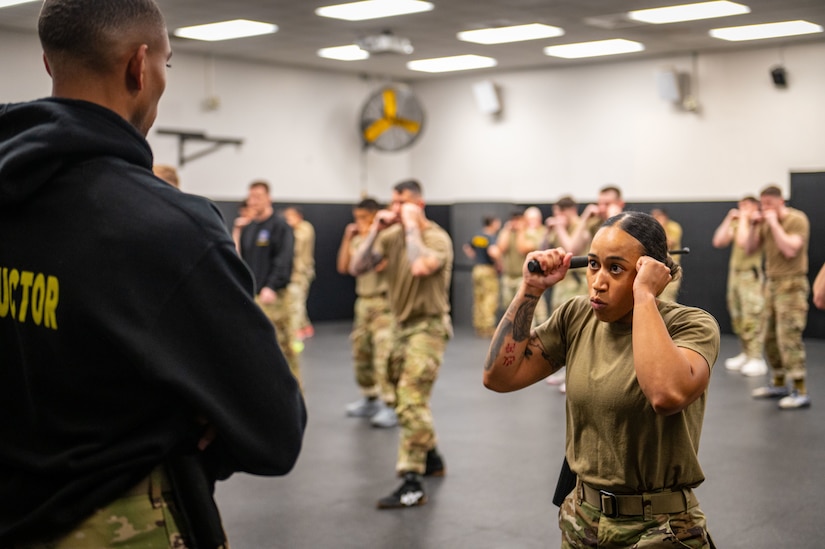
The course equips airmen with the advanced skills and adaptability required for this specialized mission. The curriculum emphasizes cross-cultural awareness, legal considerations, embassy operations, airfield assessment techniques, explosive ordnance recognition, aircraft search procedures and unarmed self-defense.
"It's our job to prepare these candidates to be able to go straight from graduation to the operational mission and to be able to perform," said Air Force Staff Sgt. Joshua Pineda, course instructor. "We tailor training to be as intense as possible and push them as hard as we can, because our teammates downrange or in hubs right now are depending on us to get it right here."
The course leadership team is composed of current Ravens, as well as subject matter experts from explosive ordnance disposal, the Air Force Office of Special Investigations and the base judge advocate office.
From Day 1, trainees are placed in an intense, fast-paced environment designed to test and exceed standard operational limits. Instructors enforce strict discipline and attention to detail, sharpening situational awareness of self, team members and surroundings.
Physical fitness is consistently integrated as a key training tool, training the mind to maintain mental clarity while replicating the physical strain and fatigue that may be encountered during real-world missions.
"We push them to their limit here. We try and redline these candidates to put them in a stress inoculation phase that pushes them out to the point where they don't know how to handle a situation," said Air Force Tech. Sgt. Michael Lex, course noncommissioned officer in charge. "We give them the baseline and the foundation to be able to push through that mental barrier, which can happen on every single mission."
Beyond the stress and mental exhaustion candidates face, conflict de-escalation tests the defenders to see if they have what it takes to earn the coveted Raven tab.
A Raven's first line of defense is communication. The course emphasizes talking as the primary method for diffusing situations. If those efforts fail, hand-to-hand combat using a baton, a nonlethal weapon, becomes their primary defense.
To practice these skills, cadets enter the "house of pain" for the initial evaluation. There, they face off against instructors and fellow students wearing distinctive red protective gear. The service member rotates continuously throughout the combative interaction, forcing cadets to adapt to shifting dynamics in the encounter.
"You never know what you're going to do until you get hit. Not many students that come through have ever been in a fight before, or have gotten hit," Pineda said. "I think the biggest misconception that students have is that there is a way to beat the [evaluation]. The point of training is to beat them but also to teach them to take the hit, keep going and get that situation under control."
As military operations worldwide evolve, the course leaders continue to play a vital role in securing assets across the globe. They maintain operational proficiency through deployments during their tenure at the training squadron. This real-world experience helps shape the curriculum and enhance credibility with students.
Weeks of classroom instruction and training for cadets culminate in a field training exercise aboard a decommissioned C-130 Hercules aircraft. Instructors transform into adversaries in scenarios based on past Raven missions, testing to see if students can navigate their way through high-stress, simulated deployment scenarios to protect their assets and personnel.
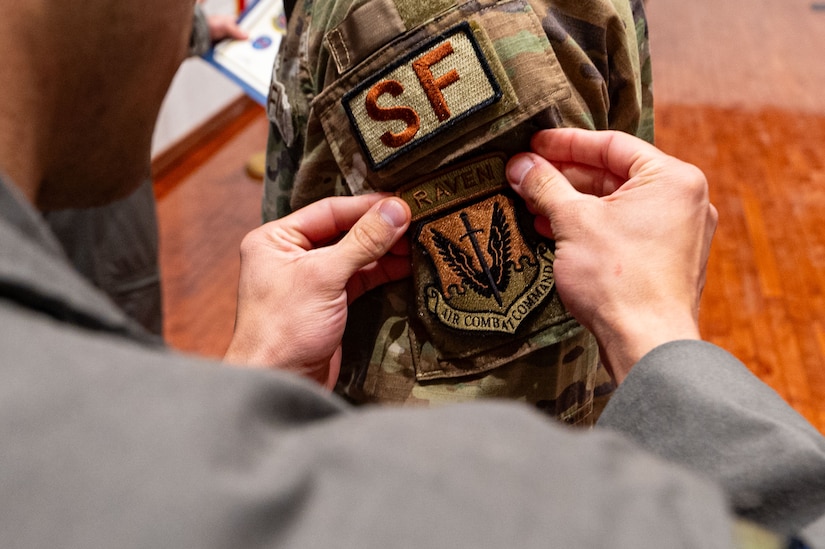
Upon completion of the course, graduates are awarded the coveted Raven tab, identifying them as certified Phoenix Ravens, members of an elite force who are ready to tackle any challenge ahead.
"I think the tab means a lot to everybody [who] wears it, because we all get trauma bonded by surviving the course or any mission that we fly on that may go the wrong way. Like in Afghanistan or Operation Epic Fury, you can experience indirect fire or drones flying at you with [weapons]," Lex said. "You might not be expecting that to happen, but when you look to your left and right, you see the Ravens [who] are there with you, and you know you will get through it together."
Ravens remain a force that is routinely called upon to protect Air Force personnel, aircraft and resources in uncertain environments around the world. Forged through adversity, discipline and trust, each graduate leaves the course carrying more than just the tab; they carry the responsibility of safeguarding the mission and legacy of those who have served before them.


 Posts
Posts


No comments:
Post a Comment