Thursday, February 08, 2018

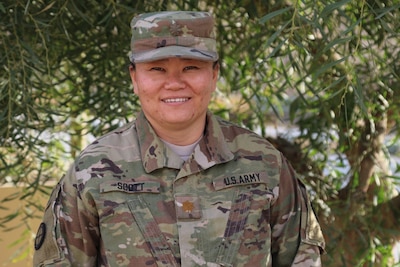
Face of Defense: Perspective, Tenacity Mark Soldier's Career


By Army Staff Sgt. Tina Villalobos, Task Force Spartan

CAMP ARIFJAN, Kuwait, Feb. 8, 2018 — Army Maj. Kimberly Scott, the logistical planner and acquisition and cross-service agreement manager for the Kansas Army National Guard’s 35th Infantry Division, is the consummate trailblazer -- she sees her world as an opportunity yet to be accomplished, rather than a path fraught with obstacles.

Hers is the hand that will reach out to pull another soldier up by her side. She's a mentor and facilitator of success; something often discussed, and less often achieved. Of course, it's only natural to wonder how such a leader came to be.

Somewhere, in an impoverished orphanage in South Korea, beginning in the early 1970s, U.S. military forces began to make an indelible mark on an impressionable little girl. These men were a beacon of light and hope, and served as the big brothers who kept Scott and her fellow orphans safe and well, at a time when darkness might have prevailed.

“I was born somewhere in South Korea, I don't know exactly where, because I was an orphan,” Scott said. “I grew up in an orphanage until I got adopted in 1986. The orphanage was built in 1953, right at the end of the Korean War. Initially, it was built for war orphans.”

According to Scott, South Korea was still a developing country at the time, and many of the children's lives were probably saved due to the care and concern of U.S. forces.

"Whenever the orphanage ran out of food, the U.S. military forces supplied food,” said Scott. “There were several times they spent Christmas with us, buying gifts. There were a couple of times that we went to their installation to have Thanksgiving and Christmas parties and they also did welfare checks on over 100 orphanage kids. The military forces did a lot for us in that orphanage.”

Second Chance

In one way or another, most of Scott's life has shown her to be exceptional. In 1986, she was the oldest child, at 13 years old, to be adopted out of the orphanage.

Scott's life changed forever when she was adopted and moved to Gettysburg, Pennsylvania, with her new family.

According to a 2015 report by The Economist, 24 babies left South Korea every day to foreign adoptions in the mid-1980s. Another 2015 article, authored by S.C.S., and published by The Economist, estimates that 85 percent of the children in South Korean orphanages today will stay there until they become adults. The reason for low adoption rates, according to the article, is that there are still social stigmas regarding adoption within the country, and changes in South Korean adoption laws have made adopting more difficult for foreigners seeking to adopt.

“The fact that American military forces were always there in a positive light for us meant a lot to me,” Scott said. “If it wasn't for the American military forces, I probably would have died a long time ago. Orphanage life was not exactly that easy. I ran away from the orphanage a lot.”

“I came back one time pretty messed up,” Scott said. “It happened to be just at the time when the U.S. military forces had showed up to do one of their health and welfare checks. I was undernourished. My body was eating itself, and I was pretty much skin and bone. They were taking pictures of me to document my condition, as the doctor was checking me and giving me vitamins and everything. It was American soldiers who took care of me until I got better. In turn, I felt that I could at least do something. I think probably my childhood had a lot to do with my decision to join the military.”

Beating the Odds

After graduating high school, Scott enlisted in the Marine Corps where she attained the rank of lance corporal. Again a statistical outlier, Scott was among the 7.7 percent of active-duty female Marines during that time.

“I got out of the Marines on June 7, 1997, and joined the Missouri National Guard on June 22, 1997,” Scott said. “I was enlisted as a Marine and I was also enlisted when I first came into the Army National Guard.”

Scott's propensity to serve went beyond her military service and extended to her community after she left the Marine Corps.

“After I got out of the Marine Corps, I went to the police academy and became a deputy sheriff for the Platte County Sheriff's Department,” Scott said. “I did that for over 14 years, and then I got out of law enforcement.”

According to a Bureau of Labor and Statistics report, in 2012, only 12 percent of police patrol officers were women.

“I went up to the rank of sergeant on the enlisted side,” Scott said. “I knew eventually that I wanted to go to the officer side of it, because there are certain things you can do as an enlisted soldier, but you can't entirely take care of people at the level I wanted to -- so, I thought that by becoming an officer, I could actually make some positive changes.”

After she became a mother, Scott felt it was even more important to push forward and further her education and career endeavors by working toward becoming an officer in the Army National Guard.

“About the year 2003, after I had my son, that's when I made the decision that I was going to go officer. I started my phase zero in January of 2004. Then I went to Officer Candidate School, and graduated in September of 2005. I went through OCS the traditional way.”

Becoming part of the 9 percent of the U.S. population to hold a master's degree, according to the National Center for Education Statistics, and having graduated through the traditional OCS, Scott now felt she had the experience and education to affect a greater depth of mentorship and assistance among her troops.

Standing Out

Scott's diverse military experiences have enabled her to be well-rounded and offer sound advice to soldiers. She has been a bulk fueler, a military police officer, worked in communications, logistics, as a human resources officer, a plans and operations officer and in several managerial positions within the military.

In a traditionally male-dominated occupation and among literally thousands of peers, standing out is a feat to be admired. A 2014 demographics report published by the Office of the Deputy Assistant Secretary of Defense for Military Community and Family Policy offers a glimpse into Scott's exceptional accomplishments.

The report indicated that out of a total force size of 354,072 Army National Guardsmen, there were 6,710 majors. The number of officers in grades O-4 to O-6 included 10,562 men and just 1,363 women.

With all of her accomplishments, Scott's most gratifying military moments have been in the service of her military family and in helping comrades to succeed.

“The most rewarding jobs in my military career have been becoming a platoon leader and company commander. My platoon was 43 soldiers, including me, and working one-on-one with them -- that's the part I enjoyed the most,” Scott said. “I remember I had a soldier that wanted to go to Air Assault School. I worked with squad leaders and team leaders to get that soldier developed. He's now an officer. I am actually really proud of him. He is a great officer!”

As a citizen-soldier, Scott has found gratification in her civilian occupation as well. She leads a team of 10 employees as a Defense Department contractor for the Mission Command Training Program at Ft. Leavenworth, Kansas, where her team, in conjunction with more than 500 other facilitators, creates up to five corps, division, or brigade-level warfighter exercises per year. Warfighter exercises help to prepare soldiers for deployments, as they simulate conditions soldiers might encounter downrange in their varying military occupational specialties.

Military careers are often made or broken by the soldiers themselves, according to Scott. She encourages soldiers to take charge of their careers, and says that attitude plays a huge role in their outcomes and the quality of their experiences.

“Everyone's eyes are on you as a member of the U.S. military forces,” she said. “Watch out what you do and what you say. Watch your actions, because there may be a little orphan kid keeping an eye on you. You may affect that kid, because they're putting you on a pedestal.”

Monday, January 15, 2018

Thinkers Strategize in DoD’s Innovation Corps Boot Camp


By Lisa Ferdinando DoD News, Defense Media Activity

WASHINGTON, Jan. 15, 2018 — Forty innovative thinkers from the four military services gathered here last week for a class where they tested out new methods to solve problems in the Defense Department.

Joshua Marcuse, executive director of the Defense Innovation Board, acknowledged the participants likely would encounter resistance in DoD when trying to solve problems with new approaches. His message to them: Keep fighting.

"When you hit that barrier, I want you to figure out a way to push forward," Marcuse said Jan. 12, closing out the weeklong class. "When the going gets tough, you need to hang in there."

The military and civilian personnel in the DoD pilot of the Innovation Corps boot camp learned about and applied the Lean Startup principles, which aim to solve problems and develop products faster and with less waste.

New Approach to Problem Solving

The class was the first time the boot camp was held for DoD-wide participants, Marcuse pointed out. Previous efforts encompassed the intelligence community.

It is critical that leaders are receptive to new approaches to problem solving, he said. Otherwise, innovative thinkers who continually face opposition might stop trying to be change agents, resigning instead to be a “cog in the machine,” he said.

Another scenario, he explained, is that these thinkers might “fight the fight a different way,” taking their ideas and talents into the private sector.

"But they're not fighting shoulder to shoulder with you in your trench at that point, or in your foxhole -- and we need them in the foxhole next to you,” Marcuse said.

Importance of Operating with Agility

The Defense Department has proven it can be highly innovative and operate with extreme agility, as it has done in the battlefields in Iraq and Afghanistan, Steve Blank, the founding father of the principles for Lean Startup, said via phone today to DoD News. But, he added, resistance in innovation is encountered back home, as the DoD execution machinery and bureaucracy “crushes whatever we did in the field.”

Blank underscored the importance of agility and innovation in the Defense Department as the United States faces near-peer state adversaries and a host of evolving nonstate threats.

In recent decades, he said, the United States essentially faced a single threat – the Soviet Union – and built organizations, structures and capabilities to counter it with the luxury of being able to respond over the course of years.

 "Fast forward to today -- we don't have one threat,” he said. “We need, in fact, a scorecard to figure out who we're dealing with.".

Today’s adversaries are “ironically not burdened with our 100 years of success," or with all the things DoD needs to support, such as contracting, procedures and other bureaucratic matters, Blank said.

The goal of the Innovation Corps and its methodologies is see how innovation and delivering solutions can be done at speed -- not just from idea to demonstration, but also from idea to deployment, he said. He recommends that each DoD and intelligence community agency establish an organization that has an innovation pipeline.

‘Eye-Opening’ Experience

Marine Corps Capt. Chris Wood, from Headquarters Marine Corps Installations and Logistics, is an innovation lead in the next-generation logistics innovation team. As a participant in the Innovation Corps boot camp, he said, he found it interesting to see the collaboration among the personnel from the different commands, including those with various levels of experience in these techniques. Tasks included conducting in-person interviews, examining the needs of the customer base, and testing a hypothesis on how to apply solutions to problem solving.

“To see them receive the training and really embrace it was eye-opening for me in that it starts to build a realization that these tools can be applied to a lot of different functions," he said.

With the world outside DoD constantly evolving, Wood said, the department needs to be agile to best respond to the threats and meet the demands of the warfighter.  

"We cannot accept doing business the same way that we have been,” he added.

Recommendations from Defense Innovation Board

The Defense Innovation Board meets Jan. 17. The 14-member panel will include in its recommendations that DoD examine whether career avenues exist in the agency for innovative thinkers who want to apply new approaches and methods to problem solving, Marcuse said.

Board member and retired Navy Adm. William H. McRaven, chancellor of the University of Texas System, said he never encountered innovation in a structured fashion in his nearly four decades in the military.

“We did innovation via technology, but it was more about finding ‘things’ that solved a certain tactical problem,” he said in a written statement, noting a process or intellectual framework to help shape thinking did not exist in the military when he served.

“Efforts to build innovation capacity in the DoD workforce are essential to renewing our competitive advantage on the battlefield," McRaven noted.

Thursday, January 11, 2018

Chief of Naval Operations Stresses Leader Responsibility


By Jim Garamone DoD News, Defense Media Activity

ARLINGTON, Va., Jan. 11, 2018 — To improve the Navy, the service must turn to commanders at all levels, the Chief of Naval Operations told the Surface Navy Association here Jan. 9.

Like the rest of the military, command is what all officers should aspire to, Navy Adm. John M. Richardson said at the association’s annual meeting.

The collision incidents last year involving the destroyers USS Fitzgerald and USS McCain called attention to the need for leadership, the admiral said.

Valuing Leadership, Command

“As we craft our way forward, we must revolve around a Navy that values and treasures command -- never lose sight of that,” Richardson said.

Service members, he added, must discuss, “the preparation, the support, the execution, indeed, the celebration of command.”

Good leadership propels the military forward, said Richardson, who added that all leaders must understand that they are in a competitive environment, and there is no trophy for second place in war.

The Navy in 2018 is in a different environment than just a few years ago, he said. Russia and China are competitors now. Both countries have made significant investments in their militaries and the United States is, again, involved in great power competition, not seen since the Cold War.

Developing Winning Leaders

The Navy must “develop leaders, especially commanders, who know how to go out into that great power competition and come back winners,” the admiral said.

The top leaders or commanders “inspire their teams to perform at or near their theoretical limits, and by making their team stronger, they relentlessly chase best-ever performance,” Richardson said. “They study every text, they try every method, seize every moment and expend every effort to out-fox their competition.”

The best commanders challenge their teams and themselves, he said. “They routinely seek out feedback and are ready to be shown their errors in the interest of learning and getting better. When they win, they are grateful, they are humble, and generally [feel] spent from their efforts. And by doing all these things, great leaders bring their teams to a deeply shared commitment to each other in the pursuit of victory.”

Victory and winning must be the focus, Richardson said. “Today’s [commanders] must be prepared for winning in a great power competition war at sea,” he said. “They must be preparing their teams on the bridge, in combat, in engineering, at their guns, to win in combat.”

This means commanders must be ready to lead teams into combat against a competent and advanced enemy and win, the admiral said. In naval terms, they must be the ones “to sail away with their crew and leave the enemy out of action, slipping beneath the waves. It’s a stark test, but anything else, anything less, is negligence.”

Confident, Humble Leaders

Commanders must be confident enough to lead and humble enough to understand they are not the font of all wisdom, Richardson said. “In combat, the best idea is the only thing that matters,” he said. “[Commanders ask] people to challenge their thinking, their ideas, because they know it’s much better to find a weakness, much better to find a flaw in the discussion in the ward room or with the Chief’s quarters, or in the crew’s mess and adjust before finding that flaw in combat. And combat will find that flaw.”

Commanders must have complete devotion to their teams, he said. “They bring their teams into their obsession with winning, constantly communicating, constantly building them up, challenging them,” the admiral said.

The best commanders always test their teams, the admiral said. “These leaders are always stretching their teams -- stretching them to achieve their theoretical limits,” Richardson said. “[Then the team] starts to push themselves and one another, and they build toughness into themselves -- toughness focused on defeating an enemy, not toughness as focused on tearing each other down.”

Through these efforts, commanders achieve a combination or a shared vision of winning, and a shared commitment to that goal, the admiral said.