Monday, January 08, 2018

Face of Defense: Okinawa-Based Marine Leads by Example


By Marine Corps Cpl. Bernadette Wildes 31st Marine Expeditionary Unit

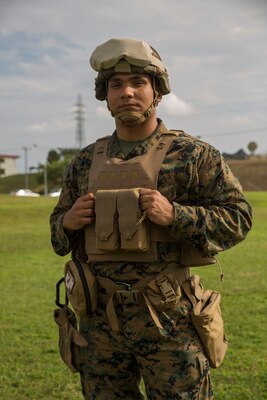
CAMP HANSEN, Japan, Jan. 8, 2018 — “I could care less about the awards, the rank, or any of the stuff that I’ve been given,” said Marine Corps Cpl. Noel Mayorqa. “I want to be an example to my squad. That’s what I strive for.”

Mayorqa, a squad leader with Alpha Company, Battalion Landing Team, 1st Marine Battalion, 1st Marine Regiment here, ensures the platoon leader’s intent is being met by making sure each task is done quickly and efficiently. He’s also in charge of accountability, training and the general well-being of his squad. He knows each job within his squad with great detail so he can help guide and shape his squad to perfectly execute the mission.

“I’ve learned everything about being a radio operator from him,” said Lance Cpl. Mason Townsley. “He taught me how to communicate, how to be a better rifleman and how to be a better person.”

Townsley, a radio operator in Mayorqa’s squad, said he doesn’t want to be in any other squad because of Mayorqa’s leadership. “He never lets us slack off,” Townsley said. “He always strives for us to be better, and he’s always pushing to improve himself. It’s really awesome working with someone who is very dedicated to his job.”

Learning Curve

Mayorqa started his career at Marine Barracks Washington, also known as “8th and I” for the intersection near the main gate. The base is home to the Corps’ ceremonial units, and Mayorga said he spent his two years there focused on drilling for ceremonies. He participated in more than 150 standard funerals, 50 full-honors funerals and four different special teams.

“They are really strict on the little things -- the way your uniform looks, the way you drill,” he said. “They always told me that the little things matter. I got a lot of discipline from 8th and I. They also taught me to be confident, respectful and humble.”

Mayorqa said when he checked in with his unit here, he didn’t know anything about being a rifleman. The newer Marines knew more than he did, but that didn’t slow him down. He came to the unit with a positive attitude and ready to learn, said Marine Corps Staff Sgt. Stuart Sanford, the platoon sergeant for 3rd Platoon, Alpha Company.

“He didn’t know everything, but we threw him in a lot of different positions,” Sanford said. “He excelled, and is now one of the best squad leaders in Alpha Company.”

Mayorqa said once he started to learn the information he just wanted more.

“I didn’t do it to stand out with my peer group or be the best,” he said. “I did it because I wanted to know my job and I wanted to share the knowledge that I know. I want to better myself so I can better the Marines to my left and my right.”

Mayorqa said he plans to stay in the Marine Corps as long as he can to continue to push himself and the Marines around him.
“It’s never been about me when it comes to the Marine Corps,” he said. “It was for the brothers to the left and right of me. I wouldn’t be where I am today if it weren’t for my Marines.”

Friday, January 05, 2018

Army Mentors Prepare High Schoolers for Success


By Army Sgt. Christopher Hernandez 345th Mobile Public Affairs Detachment

SAN ANTONIO, Jan. 5, 2018 — On a brightly lit football field inside the Alamodome here, a disparate chorus of clamor and musical instruments reverberates throughout the structure as high school football players and band members practice for the performance of their lives, the 2018

These young men and women train with soldier mentors, elite members of the Army fit to provide professional guidance and inspiration.

Soldier mentors are a prominent feature of All-American Bowl Game Week, an annual event that highlights the nation’s foremost high school football players and marching band teams.

“We do this every year because it’s a great way to put the Army’s message out,” said Army Sgt. 1st Class Brian Waters, a native of Orlando, Florida. “We let the students know that we’re here for them, answer any questions that they have, and lift them up and support them in their future endeavors.”

In addition to attending practices and events throughout the week, the soldier mentors also engage with the players in community service activities for nonprofit organizations and medical centers.

“I’ve seen throughout the years the benefits that the Army gets from these games, as well as for the community of San Antonio,” said Army Staff Sgt. Joseph Lei-Sam, a native of Samoa and the Soldier Mentorship Program manager for the All-American Bowl. “It’s very humbling, and it’s an honor to be here and represent the Army during these games.”

Cultivating Relationships

As the noncommissioned officer in charge of the mentorship program, Lei-Sam oversees all of the soldier mentors and their activities with the students. This includes planning events that cultivate deeper relationships between the soldier mentors and the students.

“For this year, I’ve also implemented new things such as the 7-on-7 flag football game, so we can further build camaraderie between [the soldiers] and the high school football players,” Lei-Sam said.

Lei-Sam and Waters both said a major goal of the Soldier Mentorship Program is to bolster the players’ career aspirations. Lei-Sam said he hopes that these football players end up in the National Football League someday, and that as they progress in their careers, the players will see what the Army is about and how soldiers live up to the Army values.

“It’s a privilege to be here with all of these students,” Waters said. “All of them are future collegiate players potentially going into [colleges with high-level football programs], and they’ve all been very supportive of the military.”

Brandon Brady, a varsity football player and student of Bryon P. Steele II High School in Cibolo, Texas, said this experience is a great opportunity to train alongside soldiers.

“[The soldier mentors] are definitely role models to each and every one of us,” he said. “In just seeing their discipline and the way they do things, it’s going to carry over to us in football and in life. It’s amazing to be able to share this moment with them, play against them, and have some fun.”

The 2018 All-American Bowl will take place at the Alamodome tomorrow, at 1 p.m. EST, and will be televised live by NBC.

Thursday, December 21, 2017

Face of Defense: Youth ChalleNGe Academy Leads to Airman’s Service


By Air Force Airman 1st Class Mercedee Schwartz, 124th Fighter Wing

BOISE, Idaho, Dec. 21, 2017 — The road that leads someone to serve in the Idaho Air National Guard isn’t always the most traditional route.

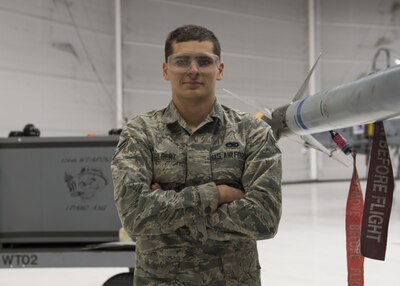
Airman 1st Class Cody Gilbert, an aircraft armament systems specialist with the 124th Maintenance Group at Gowen Field here, decided to join after attending the Idaho Youth ChalleNGe Academy.

The academy is part of the National Guard Youth ChalleNGe Program, which helps at-risk youth earn their high school diploma or General Equivalency Diploma (GED). The program emphasizes self-discipline, personal responsibility and positive motivation to help Idaho teens with a tough, disciplined education, all within a caring and respectful environment.

The Idaho National Guard, along with the state of Idaho, funds the IDYCA, which is located in Pierce, Idaho.

“It’s a quasi-military school, so you have military trainers that do things to help you figure out what you’re doing with your life,” Gilbert said.

Gilbert described IDYCA as a place that helps kids to grow and become better people.

Turning Point

Attending and graduating from the academy, he said, was a turning point in his life.

“I just wanted to be able to move ahead in life,” Gilbert said.

The program is five-and-a-half months long and has eight core components: academic excellence, leadership and followership, life coping skills, job skills, service to the community, responsible citizenship, health and hygiene, and physical fitness.

Gilbert said he had always been interested in joining the military, but after attending the National Guard-funded IDYCA, and doing additional research he decided to stay close to home and joined the Idaho Air National Guard.

Although he said his experience was worth it, he admitted that IDYCA was tougher for him than going through basic military training for the Air Force, but it has benefitted him as an airman because it’s something that most people don’t have.

Changed Perspective

“It has changed my perspective on a lot of things,” Gilbert said. “I used to be way different, but after going through the academy, basic, and tech school it changes the way you see the world.”
Gilbert said the academy changes people and it’s not worth it to give up; a person just has to keep pushing. Gilbert didn’t give up and the challenges that he faced while attending IDYCA have led him to successfully serve in the IDANG.