Showing posts with label leadership. Show all posts

Friday, May 15, 2026

The Silent Square of Leadership

Among the working tools of Freemasonry, few possess deeper symbolic meaning than the Square. It is the emblem of virtue, integrity, and moral conduct. Yet within the ritual itself lies a quieter lesson often overlooked. The Square, representing the Worshipful Master—the leader of the lodge—is placed first upon the altar and removed last when the work is complete. In that simple act, Freemasonry communicates one of the oldest truths of leadership: the leader is the first to arrive and the last to leave.

The symbolism is neither accidental nor decorative. It reflects an expectation that leadership is rooted not in privilege, but in service. The Master does not stand above the lodge as a ruler detached from labor. He stands responsible for it. Before the brethren arrive, he prepares the work. After they depart, his obligations remain. The Square stays because the duties of leadership continue long after recognition fades.

This principle closely parallels what modern scholars describe as servant leadership. Robert K. Greenleaf argued that the true leader is not defined by authority alone, but by a willingness to serve first. Greenleaf wrote:

“The servant-leader is servant first… It begins with the natural feeling that one wants to serve, to serve first.” (Greenleaf, 1970, p. 7)

Freemasonry expressed this concept symbolically long before it was formally named in academic literature. The Master’s role is not ceremonial prestige; it is enduring responsibility. The Square is placed first because leadership must begin before others are ready to labor. It is picked up last because leadership remains after others are finished.

History’s greatest military leaders often embraced this same philosophy. George Washington, perhaps the most recognized Masonic military leader in American history, understood that leadership depended upon visible personal conduct. He wrote:

“Example, whether it be good or bad, has a powerful influence.” (Washington, 1788/1939, Vol. 29, p. 492)

Washington’s words reveal why the Square occupies its symbolic position. Leadership is contagious. A leader’s discipline, punctuality, sacrifice, and composure spread throughout the organization just as quickly as laziness or indifference. If the Master arrives unprepared, the lodge becomes unprepared. If he approaches the work with seriousness and integrity, the brethren are far more likely to do the same. The Square is first because example must come before instruction.

General Douglas MacArthur echoed this same belief nearly two centuries later in his famous address to the cadets at West Point:

“The officer must set the example.” (MacArthur, 1962)

MacArthur’s statement was simple, but profound. Rank alone cannot inspire loyalty or excellence. Men follow conduct more willingly than commands. The officer who avoids hardship while expecting sacrifice from others eventually loses moral authority. The same principle applies within the lodge. The Worshipful Master cannot ask the brethren for dedication if he himself is absent from the labor. The Square remaining until the close of the lodge symbolizes that leadership does not retreat from responsibility when the work becomes inconvenient or exhausting.

Even among enlisted men turned battlefield heroes, the same lesson appears. Audie Murphy, the most decorated American combat soldier of the Second World War and a Freemason, became legendary not merely because of bravery, but because he consistently led from the front. Murphy stated plainly:

“You lead from the front.”

Though brief, the statement captures the ancient understanding shared by soldiers and Masons alike: true leadership is visible. The leader does not push others into danger while remaining safely behind. He stands where the burden is greatest. Within Freemasonry, this symbolism is reflected in the Master’s position at the head of the lodge, bearing responsibility for its harmony, instruction, and conduct.

The lesson of the Square also challenges many modern ideas about leadership. Contemporary culture often associates leadership with status, visibility, or personal advancement. Freemasonry teaches something different. The Square reminds us that leadership is often quiet, repetitive, and unnoticed. It is arriving before anyone else to prepare the lodge room. It is mentoring younger brethren after meetings have ended. It is ensuring harmony during disagreement. It is carrying responsibility even when no recognition follows.

The operative origins of the Square deepen this symbolism further. In stonemasonry, the square ensured that the structure being built would stand true. A wall improperly squared endangered the stability of the entire building. Likewise, weak or careless leadership threatens the moral stability of the lodge itself. The Master must therefore embody consistency, steadiness, and upright conduct so that the symbolic temple remains strong.

The ritual action of placing the Square first and removing it last therefore teaches a timeless principle. Leadership is not about occupying the highest seat. It is about bearing the longest burden.

The Square is silent, yet its lesson endures.

The leader arrives first.

The leader leaves last.

And between those moments, he sets the example by which all others labor.

References

Greenleaf, R. K. (1970). The servant as leader. Robert K. Greenleaf Center.

MacArthur, D. (1962, May 12). Duty, honor, country. Address delivered to the Corps of Cadets, United States Military Academy, West Point, NY.

Murphy, A. Quoted in military leadership collections and biographical summaries of Murphy’s battlefield leadership.

Washington, G. (1939). The writings of George Washington (J. C. Fitzpatrick, Ed., Vol. 29). U.S. Government Printing Office. (Original work written 1788)


Sunday, April 19, 2026

Be the Lighthouse: How Leaders Provide Direction in Uncertain Times

In the age of sail, a ship caught in fog did not need more speed, more noise, or more commands shouted across the deck. It needed a fixed point of reference. It needed a light.

Today’s organizations are no different. The fog is not made of weather, but of uncertainty—technological disruption, institutional distrust, rapid change, and conflicting information. Leaders often respond by trying to do more: more meetings, more directives, more urgency. But in uncertain times, leadership is not about increasing activity. It is about increasing clarity.

The most effective leaders understand a simple but often overlooked truth: they are not the ship, and they are not the storm. They are the lighthouse.

A lighthouse does not chase ships. It does not control outcomes. It does not eliminate danger. What it does is far more powerful. It provides visibility, consistency, and guidance in environments where none exist. These are the essential functions of leadership when conditions are at their worst.

First, the lighthouse is visible. Its presence alone reduces uncertainty. Research on leadership communication consistently shows that employees interpret silence from leadership as a signal of instability or concealment. When leaders are absent or quiet, people fill the void with assumptions, often negative ones. Men (2014) found that transparent and frequent communication from leaders significantly increases employee trust and engagement. Visibility is not performative; it is stabilizing. If people cannot see their leaders, they begin to question whether leadership exists at all.

Second, the lighthouse is consistent. The light does not flicker based on conditions or convenience. It operates with reliability, and that reliability becomes its value. In organizational life, inconsistency in leadership messaging is one of the fastest ways to erode trust. Dirks and Ferrin (2002) demonstrated that trust in leadership is strongly correlated with predictable and aligned behavior over time. Teams do not require perfection. They require dependability. A leader who changes direction without explanation, or who communicates conflicting priorities, creates confusion that spreads faster than any external crisis.

Third, the lighthouse is positioned with intention. It stands where it matters most—at points of danger, transition, or decision. Leaders often mistake motion for effectiveness, moving from issue to issue, reacting instead of anchoring. But leadership is not defined by movement; it is defined by positioning. A leader grounded in clear values and strategic priorities provides a reference point for others. This is consistent with research on authentic leadership, which emphasizes self-awareness and value alignment as core drivers of effective leadership behavior (Avolio & Gardner, 2005).

Fourth, the lighthouse warns rather than controls. It does not steer ships. It reveals hazards and illuminates safe passage, allowing others to make informed decisions. This distinction matters. Leaders who attempt to control every outcome create dependency and slow decision-making. Leaders who provide clarity create capability. In complex environments, where no single person has complete information, the role of leadership shifts from directing action to enabling judgment. Heifetz, Grashow, and Linsky (2009) describe this as adaptive leadership—the ability to mobilize people to tackle challenges that do not have clear or immediate solutions.

The absence of these functions has predictable consequences. When the light goes dark, organizations do not pause. They fragment. Communication breakdowns lead to speculation. Inconsistent signals erode credibility. Decision-making slows as individuals hesitate without clear guidance. Over time, the organization begins to drift—not because people are unwilling to act, but because they no longer share a common direction.

These are not theoretical outcomes. Studies on organizational trust have shown that low trust environments are associated with decreased performance, reduced collaboration, and increased turnover intentions (Dirks & Ferrin, 2002). What begins as a communication issue becomes a structural problem. What begins as uncertainty becomes dysfunction.

The challenge for leaders today is that the environment itself has become more complex. Information is abundant, but clarity is scarce. Digital transformation, including the rise of artificial intelligence, has accelerated decision cycles while increasing ambiguity. According to the World Economic Forum (2023), leaders are now required to navigate rapid technological change while maintaining workforce trust and organizational coherence. The storm is not only external. It is cognitive, cultural, and continuous.

In this environment, being the lighthouse is not a passive role. It requires discipline.

Leaders must communicate early and often, even when information is incomplete. Research indicates that transparency, even under conditions of uncertainty, strengthens credibility more than delayed or withheld communication (Men, 2014). Silence, by contrast, invites speculation.

They must anchor to principles rather than trends. Values provide continuity when conditions change. Without them, leaders become reactive, shifting direction based on the latest pressure rather than a coherent strategy.

They must make decisions visible. It is not enough to decide; leaders must explain the reasoning behind decisions. This builds understanding and reinforces alignment.

They must absorb pressure rather than transmit it. Stress within organizations is often amplified by leadership behavior. A leader who reacts with urgency and anxiety transfers that state to the team. A leader who maintains composure creates space for rational thought and effective action.

Finally, they must develop internal stability. The external role of the lighthouse depends on internal grounding. Leadership is often portrayed as a public function, but its most critical moments are private. Decisions are made in solitude, under conditions of incomplete information and competing pressures. Integrity is not tested when actions are visible. It is tested when they are not.

This internal dimension of leadership aligns with long-standing research on moral and authentic leadership, which emphasizes the role of internalized values and self-regulation in guiding behavior (Avolio & Gardner, 2005). Before leaders can provide direction to others, they must be anchored themselves.

The metaphor of the lighthouse endures because it captures something essential about leadership that is often overlooked. Leadership is not defined by control, visibility in the media, or the volume of directives issued. It is defined by the ability to provide clarity when clarity is most needed.

The storm will not disappear. The fog will return. Conditions will remain uncertain. These are constants.

What can change is the presence of the light.

A leader does not need to control the sea. The leader must ensure that, in the darkest moments, there is still something others can see, trust, and follow.

References

Avolio, B. J., & Gardner, W. L. (2005). Authentic leadership development: Getting to the root of positive forms of leadership. The Leadership Quarterly, 16(3), 315–338.

Dirks, K. T., & Ferrin, D. L. (2002). Trust in leadership: Meta-analytic findings and implications for research and practice. Journal of Applied Psychology, 87(4), 611–628.

Heifetz, R., Grashow, A., & Linsky, M. (2009). The practice of adaptive leadership: Tools and tactics for changing your organization and the world. Harvard Business Press.

Men, L. R. (2014). Strategic internal communication: Transformational leadership, communication channels, and employee satisfaction. Management Communication Quarterly, 28(2), 264–284.

World Economic Forum. (2023). The future of jobs report 2023. World Economic Forum.

Sunday, March 29, 2026

Can Do, Will Do, and Does What Is Right: Leadership Lessons from the Age of Sail

Leadership is often described through action—what leaders do, how they decide, and how they influence others. Yet beneath those actions lies a more fundamental question: why do people choose to follow? The answer is trustworthiness. Trust is not automatic; it is earned through consistent demonstration of competence, care, and character. Research in organizational leadership identifies three core elements of trustworthiness—ability, benevolence, and integrity—as the foundation upon which trust is built (Colquitt, Scott, & LePine, 2007).

This article introduces both a framework for understanding trustworthiness in leadership and a broader work in progress, Age of Sail. This book examines leadership not through abstract theory alone, but through the lived experiences—fictionalized, yet deeply realistic—of naval officers during one of the most demanding periods in history. At sea, leadership is immediate and unforgiving. There is no time for theory when a storm is rising or an enemy ship is closing. It is in these moments that leadership is revealed.

From these experiences emerges a simple framework: a leader can do, a leader will do, and a leader does what is right.

Trustworthiness as the Foundation of Leadership

Trustworthiness is built on three dimensions: ability, benevolence, and integrity. Ability reflects competence; benevolence reflects intent toward others; and integrity reflects consistency with ethical principles. These elements are not interchangeable—they each independently contribute to trust and are strongly related to outcomes such as performance and risk-taking behavior (Colquitt et al., 2007).

In practice, this means that followers are constantly evaluating their leaders, asking three fundamental questions:

  • Can this person lead me?

  • Will this person act in my best interest?

  • Will this person do what is right?

The Age of Sail provides vivid answers to each of these questions.

Can Do: The Foundation of Competence

The first test of leadership is competence.

In Treason’s Harbor, Captain Jack Aubrey faces a sudden squall—one of the most dangerous conditions a sailing vessel can encounter. The wind shifts violently, visibility drops, and the margin for error disappears. There is no committee, no delay, no second chance. Orders must be given immediately, and they must be correct.

Aubrey does not hesitate. He acts with precision, issuing commands that his crew executes without question. What is striking is not just his decisiveness, but his expectation: competence is assumed. Seamanship is not praised; its absence is condemned as “discreditable, if not downright wicked” .

In that moment, trust is not discussed—it is demonstrated.

The crew follows because they know he can do the job.

This reflects the core principle of ability. Without competence, leadership fails before it begins. Research confirms that ability is one of the strongest predictors of trust, as followers must believe their leader has the skills necessary to succeed (Colquitt et al., 2007).

Competence creates credibility. And credibility is the first step toward trust.

Will Do: The Test of Intent

Competence answers the first question, but it leads immediately to the second:

Will this leader act in my best interest?

This is the domain of benevolence.

In the Ramage series, Nicholas Ramage demonstrates a different kind of leadership. He is not only competent—he is intentional in how he develops his men. One of his officers reflects that Ramage is like a mirror, showing a man not who he is, but who he could become—and leaving him believing that he is that man.

This is not authority. This is influence.

Ramage does more than command; he invests in his people. He recognizes potential, builds confidence, and creates an environment where individuals rise to meet expectations. His leadership is not about control—it is about growth.

This is benevolence in practice.

It is also reflected in the culture aboard naval ships, where leaders rely on the strengths of their crews and foster mutual respect. Leadership is not simply about issuing orders; it is about understanding people and aligning their abilities toward a shared purpose.

Research supports this dynamic. Benevolence signals to followers that a leader’s intentions are not self-serving, which increases trust and strengthens commitment (Colquitt et al., 2007).

People may follow a competent leader.
They commit to a leader who cares.

Does What Is Right: The Measure of Integrity

The final test of leadership is integrity.

Horatio Hornblower provides a powerful example. Known for his competence and discipline, Hornblower is equally defined by his internal standard. When he makes a mistake, he does not deflect blame. Instead, he reflects:

If it was ignorance, there was no excuse… that was incompetence, and there was no excuse for incompetence.

This is more than self-criticism—it is a commitment to principle.

Hornblower understands that leadership is not situational. Standards do not change based on convenience. Integrity requires consistency, even when it is uncomfortable or costly.

This consistency builds reputation. It also builds trust.

Followers may not always agree with a leader’s decisions, but they must believe those decisions are grounded in principles. Integrity ensures that leadership is predictable and reliable.

Research confirms that integrity is a critical driver of trust, as it signals alignment between a leader’s words and actions (Colquitt et al., 2007).

Without integrity, leadership collapses.
With it, leadership endures.

Bringing It Together: Trustworthiness in Action

The three elements of trustworthiness—ability, benevolence, and integrity—are not independent. They are interdependent, each reinforcing the others.

  • Aubrey demonstrates ability, earning immediate confidence in crisis.

  • Ramage demonstrates benevolence, building loyalty and commitment.

  • Hornblower demonstrates integrity, sustaining trust over time.

Together, they answer the three essential questions of leadership:

  • Can you lead me?

  • Will you act for me?

  • Will you do what is right?

When all three answers are yes, trust emerges.

The Age of Sail project brings these concepts to life, using narrative to bridge theory and practice. Through these stories, leadership is not simply defined—it is experienced.

Conclusion

Trustworthiness is the foundation of effective leadership. Grounded in competence, care, and character, it enables leaders to influence, inspire, and achieve results. While modern research provides a framework for understanding these concepts, the Age of Sail demonstrates them in action.

The book Age of Sail seeks to explore these lessons in depth, offering readers a narrative-driven approach to leadership. By following the journeys of fictional naval officers, readers gain insight into the realities of leadership—its challenges, its responsibilities, and its demands.

Ultimately, leadership is not proven in comfort, but in challenge. And in those moments, the same truth applies:

A leader must be able.
A leader must be willing.
A leader must be right.

References

Colquitt, J. A., Scott, B. A., & LePine, J. A. (2007). Trust, trustworthiness, and trust propensity: A meta-analytic test of their unique relationships with risk taking and job performance. Journal of Applied Psychology, 92(4), 909–927.

Forester, C. S. (1951). Commodore Hornblower. Little, Brown and Company.

Forester, C. S. (1962). Hornblower and the Hotspur. Little, Brown and Company.

Foster, R. E. (2026). Leadership in the Age of Sail (Unpublished manuscript).

Kent, A. (1972). To glory we steer (Bolitho series). Hutchinson.

O’Brian, P. (1990). Treason’s harbour. W. W. Norton & Company.

Pope, D. (1969). Ramage and the drumbeat. Weidenfeld & Nicolson.

Monday, February 16, 2026

Pentagon Press Secretary Celebrates Air Force Leadership School Graduates at Nationals Park

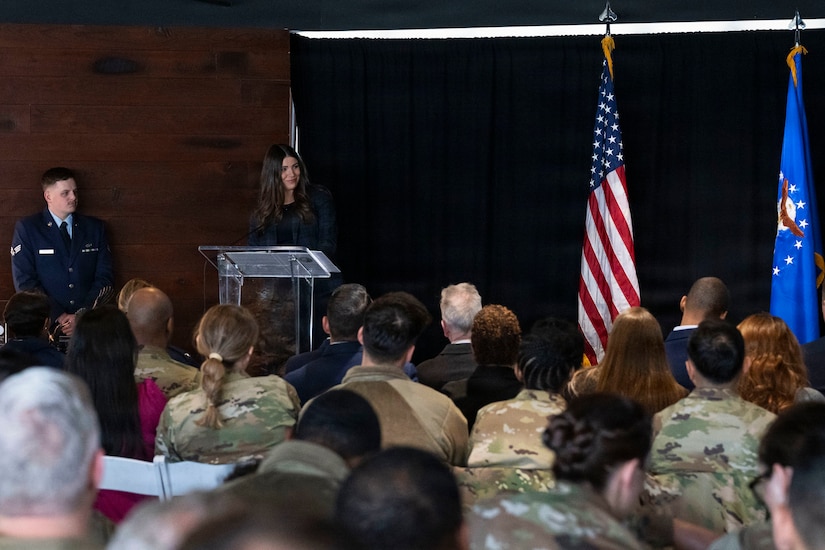
Airmen and guardians traded in a traditional auditorium for the ballpark as they celebrated their graduation from the Donald L. Harlow Airman Leadership School at Nationals Park in Washington, yesterday, leaving with a bigger takeaway than a certificate: the ability to lead others.

A woman in business attire stands behind a lectern and speaks. On her left are an American flag, a blue flag with an eagle encircled by stars in the center and a brick wall with a monitor hanging from it.

Pentagon Press Secretary Kingsley Wilson attended the ceremony hosted by the 316th Wing at Joint Base Andrews, Maryland. She used her remarks to draw a straight line between her recent transition and the one the graduates are about to make. 

Washington Nationals Senior Vice President of Community and Government Engagement Gregory McCarthy introduced Wilson, and the ceremony — complete with colors, anthem and invocation — gave the graduates and their families a moment to pause and celebrate together. 

"Now you're stepping into the transition [Airman Leadership School] is built for: moving from being the one who gets the job done — to being the one who makes sure the team gets the job done," Wilson told the service members. 

A woman in business attire stands behind a lectern and speaks to more than a dozen people wearing a mix of business attire and camouflage military uniforms. A man in a formal military uniform stands to her right, and on her left are an American flag and a blue flag with an eagle encircled by stars in the center.

The leadership school is the first level of enlisted professional military education and a milestone required before being promoted to staff sergeant, Wilson said. The course is 192 hours over 24 academic days focused on culture, mission, leadership and problem-solving — training designed to help the service members think and respond when the environment is "complex and ambiguous." 

Wilson didn't spend much time on the curriculum, however. Instead, she spoke about what happens when responsibility shows up faster than you expect. 

"A lot of you are in the same [stage] of life I'm in," she said. 

Not long ago, Wilson said, she was early in her career, "learning fast, trying to earn trust," working in communication, where the pace is relentless and mistakes travel fast. Then she took the oath as a presidential appointee and became the Pentagon press secretary. 

"Overnight, my job changed. I didn't just have tasks — I had a mission," she said. "And I learned quickly that leadership is not about having a title. It's about carrying responsibility." 

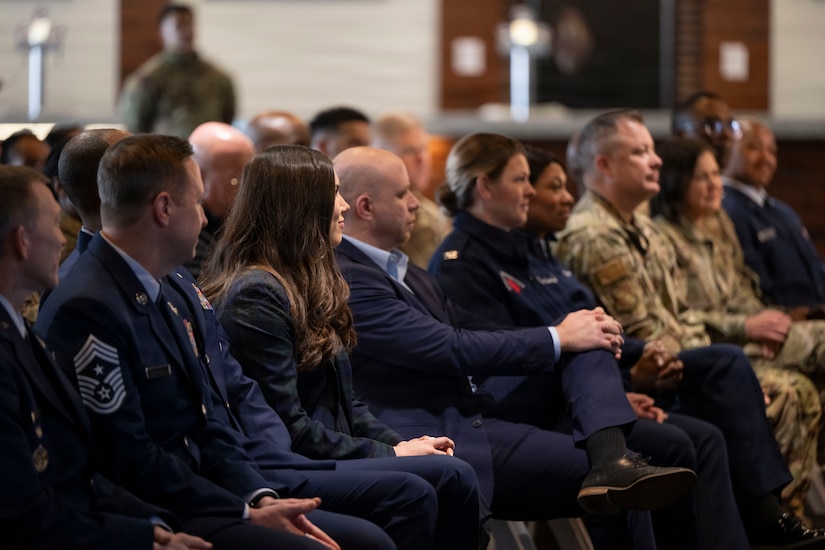
More than a dozen people, wearing a mix of business attire, formal military uniforms and camouflage military uniforms, sit in an indoor ceremony.

That's the same shift the Airman Leadership School is built to reinforce, Wilson told the graduates — becoming the first line of leadership for junior enlisted who are learning the job, testing boundaries and sometimes wondering if they belong. 

Wilson offered three lessons she said apply "directly to the stripes you're stepping into."

First, she told them, "clarity is key." New supervisors shouldn't hide behind buzzwords or overcomplicate guidance.  

"Give clear standards, clear expectations and clear feedback," she said. "Confusion is not a strategy. Clarity is." 

Second, Wilson said, "standards are not optional." Leaders can feel pressure to make things easier or accept "good enough," she warned, but subordinates watch what supervisors tolerate. "If you want a culture of excellence, you must enforce excellence — quietly, consistently, every day." 

Finally, Wilson reminded the service members to take care of people "the right way — by building them into warfighters."  

Mission and people aren't competing priorities, she said, the mission depends on warfighters who are trained, disciplined and trusted — and leaders who coach, correct and protect them "not from standards, but from confusion, chaos and bad leadership."

More than a dozen men and women wearing formal military uniforms stand in a stadium, posing for a picture around a man and a woman in business attire. A snow-covered baseball field is in the background.

With the ceremony taking place in a baseball stadium, Wilson used the setting to make her point. "Leadership is not a solo sport," she said, comparing effective supervision to teams that do the basics together: communicate, cover each other and adjust when something goes wrong. 

In a class made up of active-duty service members from 19 career fields and units across seven major commands, Wilson said the details of each job may differ — but the expectations of a noncommissioned officer don't. 

"You are ready for that — not because you're perfect, but because you've been trained, you've been tested, and you've chosen to step forward," she said. 

Before leaving the podium, Wilson thanked the families and friends for standing behind the graduates, then closed with a reminder meant to sound simple — and to be taken seriously. 

"So let me be crystal clear on one last point: you earned this. Congratulations!" she said. "Now go lead."

Saturday, December 13, 2025

The Quiet Decision


The room was full, but the moment was solitary.

Everyone was waiting for a response—board members, staff, volunteers, partners—each with a different fear dressed up as advice. The spreadsheet said one thing. The polling said another. The safest option was obvious, documented, and defensible.

And yet, the leader said nothing.

He looked instead at a single line in his notebook, written weeks earlier, when the pressure was still hypothetical:

If this goes wrong, who pays the price?

Leadership rarely announces itself in speeches or votes. More often, it appears in the silence between obligation and convenience.

The proposal on the table would protect the organization’s reputation and ensure short-term stability. No one would criticize it publicly. No headlines. No angry calls. No uncomfortable explanations. It was, by every modern metric, the “right” move.

Except for one problem.

It shifted risk downward—to the people least able to absorb it.

The families. The junior members. The volunteers who trusted that decisions were being made for them, not around them.

Leadership is not the act of choosing what works. It is the act of choosing who you are willing to disappoint.

The leader closed the notebook.

He knew what would follow if he spoke against the consensus: resistance, second-guessing, quiet erosion of support. He also knew what would follow if he didn’t: applause now, regret later, and a moral debt that would surface at the worst possible time.

So he spoke.

Not loudly. Not emotionally. Simply.

“This protects us,” he said, “but it costs them. And if we exist to protect ourselves, we’ve already lost the reason we were trusted in the first place.”

The room resisted him at first. That’s normal. Leadership that costs nothing convinces no one.

But something shifted. The conversation changed. The decision slowed down. Better questions replaced faster answers.

The final vote was closer than anyone expected. The safer option lost.

Months later, when the crisis passed quietly—without recognition or reward—no one remembered the spreadsheet. But people remembered this:

When it mattered, the leader carried the weight himself.

That is the kind of leadership that does not need to announce its authority.
It earns it.

Friday, October 10, 2025

Credibility in a Distrustful Era: Rebuilding Trust as a Core Leadership Strategy

Introduction — The Age of Distrust

In a world where every word can be fact-checked in real time and every decision amplified on social media, credibility has become a leader’s most valuable currency. Surveys across sectors—from government institutions to global corporations—show a steady erosion of public trust. The 2025 Edelman Trust Barometer, for example, reveals that majorities in most nations now distrust both government and business to act ethically. In this environment, credibility is not a public relations issue; it is a survival strategy.

As Raymond E. Foster argued in Leadership: Texas Hold ’Em Style (2006), leadership resembles a high-stakes poker game played with incomplete information. Every move a leader makes is a bet, and the only way to stay in the game is to have others believe in your integrity. Credibility, like table stakes, determines whether you are invited to play the next hand. When the chips are down, people do not follow rank, wealth, or charisma—they follow those they trust.

This essay explores credibility as the central pillar of modern leadership. Through four examples—two from the private sector and two from government—it demonstrates that transparency, consistency, and authenticity are not just ethical ideals but functional necessities in the twenty-first-century leadership landscape.


The Foundations of Credibility — Knowing When to Bet, Check, or Fold

Credibility operates at the intersection of competence, character, and consistency. Competence ensures that a leader’s promises are deliverable; character ensures that those promises are honorable; and consistency ensures that trust can accumulate over time. Without all three, leadership collapses under scrutiny.

In Leadership: Texas Hold ’Em Style, Foster (2006) likened this to a poker player who must balance courage with calculation: knowing when to push forward, when to pause, and when to concede a losing hand. Credibility functions the same way—it requires restraint and judgment as much as boldness. In an age saturated with spin and digital manipulation, followers can detect insincerity almost instinctively. The leaders who succeed are those who bet on honesty, even when honesty seems risky.


Private Sector Example #1 — Satya Nadella and Microsoft’s Credibility Rebuild

When Satya Nadella became chief executive officer of Microsoft in 2014, the company was powerful but adrift. Its internal culture was rigid and competitive, defined by what insiders called “stack ranking,” a system that rewarded individual success over collaboration. Trust—both among employees and between leadership and staff—had eroded.

Nadella’s response was rooted in empathy and authenticity. He replaced the culture of rivalry with one of collective learning, introducing the idea of a “growth mindset.” Rather than presenting himself as the infallible executive, he admitted mistakes, encouraged curiosity, and re-centered Microsoft’s mission around empowerment and purpose. This transparency rebuilt internal credibility.

The results were measurable: innovation increased, employee engagement soared, and Microsoft’s market value quadrupled. More importantly, the organization regained moral authority in the tech sector. Nadella demonstrated that credibility begins within the organization. Like a poker player rebuilding a reputation after a bad bluff, he restored Microsoft’s seat at the global table by proving that trust—not dominance—was his long game.


Private Sector Example #2 — Patagonia and the “All-In” Leadership Move

Few corporate actions have symbolized credibility more dramatically than Patagonia’s 2022 decision to give away the company. Founder Yvon Chouinard transferred ownership to a trust and nonprofit designed to fight climate change, ensuring that every dollar of profit would serve environmental causes.

This was not a marketing gesture but a culmination of decades of alignment between words and deeds. Patagonia had long urged consumers to “buy less,” campaigned for national park protection, and promoted environmental activism. By surrendering control, Chouinard made the ultimate credibility bet: he went “all-in” on purpose.

The public response was immediate and overwhelmingly positive. Patagonia became a global symbol of authenticity and moral clarity in business. The lesson for leaders is simple but rare—credibility is earned through congruence between stated values and lived action. In poker terms, Chouinard showed his cards and still won, because everyone at the table already knew what he stood for.


Government Example #1 — Jacinda Ardern and the Power of Empathic Transparency

In the public sector, few leaders have embodied credibility more effectively than New Zealand’s Jacinda Ardern. During her tenure as prime minister, she confronted crises ranging from the 2019 Christchurch mosque shootings to the COVID-19 pandemic. What set her leadership apart was her extraordinary openness and emotional intelligence.

Ardern held daily briefings, communicated complex policies in plain language, and showed vulnerability when addressing national grief. Her empathy translated into unprecedented levels of trust among citizens. Even those who disagreed with specific policies often expressed confidence in her sincerity and fairness.

Foster’s poker analogy offers a revealing lens here. Ardern’s strength lay in “reading the table”—understanding public sentiment and responding with authenticity rather than calculation. She did not bluff through crisis; she played the hand she had, with compassion as her ace. This approach redefined political credibility for a generation and demonstrated that trust is not built through authority but through shared humanity.


Government Example #2 — The U.S. Military and the Rebuilding of Institutional Credibility

Few institutions face the credibility challenges confronting the modern United States military. Following controversial withdrawals and operational missteps—from Afghanistan in 2021 to civilian-casualty incidents in the Middle East—public confidence declined sharply. The perception grew that military leaders shielded mistakes behind jargon and classified reports.

In recent years, however, a quiet transformation has begun. Senior commanders have adopted a doctrine of public accountability, releasing after-action reviews, inviting congressional oversight, and emphasizing ethical education at every level of command. By confronting errors openly rather than obscuring them, the armed forces are slowly regaining legitimacy.

In Leadership: Texas Hold ’Em Style, Foster described this principle succinctly: “You don’t build credibility by pretending every hand is a royal flush. You build it by playing honestly, hand after hand.” The military’s new posture reflects that wisdom. Credibility, once lost, cannot be restored through power—it must be re-earned through humility and transparency.


The Leadership Playbook — Five Rules of the Trust Table

Drawing from these examples, modern leadership credibility can be summarized through five “rules of the trust table.” Each aligns with the strategic insights of Leadership: Texas Hold ’Em Style and applies across both private and public domains.

  1. Show Your Hand Selectively, Not Secretly.
    Transparency does not mean oversharing, but strategic honesty. Leaders who explain the “why” behind decisions cultivate followers who can tolerate uncertainty.

  2. Never Bluff Your Values.
    Authenticity cannot be faked. Once followers detect inconsistency between stated values and observed behavior, credibility collapses. Chouinard’s “all-in” gesture and Nadella’s vulnerability exemplify this rule.

  3. Read the Room, Not the Odds.
    Emotional intelligence matters more than prediction accuracy. Ardern’s empathy illustrates how listening creates legitimacy even amid disagreement.

  4. Play the Long Game.
    Credibility compounds like winnings over time. Every transparent act, every fulfilled promise adds chips to a leader’s trust bank. Conversely, every lie or deflection empties it.

  5. Cash In on Integrity.
    The endgame of leadership is not power but influence. Integrity is the currency that converts positional authority into moral authority. Leaders who treat integrity as expendable soon find themselves out of the game.

These rules are not abstract ideals. They are operational strategies for surviving and thriving in environments where distrust has become the default setting. They recognize that credibility cannot be demanded; it must be demonstrated repeatedly and consistently.


The Broader Context — Leading in the Post-Trust World

In the digital age, credibility must withstand not only human skepticism but algorithmic scrutiny. Artificial intelligence, deepfakes, and disinformation campaigns blur the line between truth and illusion. Every institution, from corporations to governments, now competes in an attention economy where misinformation spreads faster than facts.

Against this backdrop, the most credible leaders are those who cultivate predictable honesty. Their statements may be scrutinized, challenged, or misinterpreted, but their overall pattern of behavior communicates integrity. Like the disciplined poker player who never overplays a weak hand, credible leaders win by consistency, not spectacle.

Trust, once fractured, is difficult to restore. Yet as the examples above demonstrate, it can be rebuilt through deliberate, transparent action. Credibility does not require perfection; it requires accountability. It does not depend on universal approval but on consistent truth-telling.


Conclusion — The Credibility Endgame

Leadership has always been a contest of character, but in this distrustful era it is also a test of endurance. The leaders who will define the coming decade are not those who dominate headlines but those who outlast cynicism. They will be the ones who treat credibility not as a communications tactic but as the core of their strategic philosophy.

As Foster (2006) wrote, “Leadership is not about holding the best cards; it’s about playing the hand you have with integrity so others will keep playing with you.” That metaphor captures the essence of this moment. In business, politics, and civic life alike, the table stakes have been raised.

The real winners are not those who bluff the best, but those who build enough trust that others are willing to bet on them again. Credibility, in the end, is not the bluff—it’s the whole game.


References

Edelman. (2025). Edelman Trust Barometer 2025: Global Report. Edelman Research Group.

Foster, R. E. (2006). Leadership: Texas Hold ’Em Style. Midwestern Leadership Press.

Korn Ferry. (2025). Leadership trends 2025: Building credibility in an age of distrust. Korn Ferry Institute.

Microsoft Corporation. (2024). Microsoft annual culture and innovation report. Microsoft Press.

Patagonia. (2023). Patagonia purpose and ownership report. Patagonia Public Trust.

United States Department of Defense. (2024). Command accountability and ethics review summary. Office of the Secretary of Defense.

Tuesday, September 23, 2025

When Leaders Go Silent, Everyone Pays

Silence is not neutral. When leaders choose to cancel meetings, dodge questions, or withdraw from conversations at the very moments people most need to hear from them, the cost is steep: trust evaporates, conflicts harden, and legitimacy crumbles. We’ve seen this play out in the past week across politics, business, local government, and even the Pentagon.

Take President Trump’s abrupt cancellation of a scheduled White House meeting with Senate and House Democratic leaders. Facing a potential government shutdown, he announced there was no point in sitting down with “unserious” people. That refusal to even try dialogue didn’t cool tensions—it inflamed them. By stepping away, the president confirmed critics’ worst fears: that compromise is impossible. Silence in that context isn’t strength; it’s surrender of leadership.

In Australia, Optus—the nation’s second-largest telecom provider—offered another painful lesson. A 13-hour outage knocked out “Triple Zero” emergency calls, and at least four deaths have since been linked to the disruption. The company eventually admitted a firewall upgrade went wrong. But in those crucial early hours, leadership was invisible. Families couldn’t call ambulances, governments couldn’t get clear answers, and public confidence collapsed. Once again, silence created a vacuum filled by anger, grief, and blame.

Closer to home, in Beaumont, Texas, a city council member blasted the municipal communications department for failing to keep residents informed. Instead of proactive messaging, leaders relied on reactive explanations after problems surfaced. The result? A community that feels unheard and uninformed—fertile ground for rumor, frustration, and disengagement.

And at the Pentagon, the “Signalgate” scandal continues to fester. Defense Secretary Pete Hegseth has faced allegations of using unofficial Signal chats to discuss sensitive business, followed by what even former Pentagon spokespersons called a “horrible” communications response. The lack of transparency has fueled suspicion and weakened confidence in one of America’s most trust-dependent institutions.

Different domains, same pattern: leaders retreat when they should engage.

Why does this matter? Three reasons stand out. First, silence erodes trust. Whether it’s Congress, a telecom customer, or a city resident, people read withdrawal as avoidance or disdain. Once trust is lost, it’s hard to win back. Second, silence escalates conflict. Canceling a meeting or delaying a statement doesn’t buy time—it gives opponents space to harden their positions and fill the narrative with their own versions. Third, silence undermines legitimacy. Leaders gain authority not just by holding titles but by showing up, explaining themselves, and being accountable.

Leadership theory helps explain why withdrawal is so corrosive. Transformational leadership, for example, emphasizes vision, inspiration, and engagement. At its core, it’s about lifting people’s trust by being present and transparent. A transformational leader doesn’t cancel meetings with rivals; they use those moments to articulate shared purpose. They don’t hide during crises; they step forward to own the problem.

Situational leadership adds another dimension. It teaches that there’s no one best style—leaders must adapt to context. When crises erupt or tensions rise, silence is the worst possible choice. A situationally aware leader knows that those moments demand directness, reassurance, and clarity. By contrast, withdrawal shows a mismatch between leadership style and the moment’s needs.

Put simply: transformational leadership says you need to engage to build trust. Situational leadership says you need to engage when the stakes demand it. Silence violates both.

The costs of withdrawal are not abstract. In the Trump case, the chance to avert shutdown shrinks. In Optus’s case, lives were lost and reputations shattered. In Beaumont, civic faith weakens. At the Pentagon, national security credibility takes a hit.

The lesson across all four examples is straightforward: leaders who retreat when words are required inflict damage far beyond their immediate organizations.

So what’s the alternative? Leaders should preemptively engage rather than reactively retreat. They should own the narrative early, even if all the facts aren’t yet clear, and commit to regular updates. They should adapt their style to the situation—firm and directive in crises, supportive and collaborative in calmer times. And above all, they should embed transparency and accountability into their daily practice so that when storms come, trust is already there to draw on.

It’s tempting for leaders to think silence buys space to think or shields them from criticism. But in today’s interconnected, real-time world, silence is instantly filled by others—with rumors, anger, or mistrust. The cost of avoiding hard conversations is always greater than the discomfort of having them.

From Washington to Sydney, from city hall to the Pentagon, the lesson is the same: leadership is not about withdrawal. It’s about showing up when it matters most.


Thursday, August 28, 2025

The Silent Burden: How Leaders Carry Responsibility When No One is Watching

Leadership is often imagined as a role defined by speeches, decisive moments, and visible actions. Yet some of the greatest weight a leader carries is shouldered quietly—when decisions must be made without recognition, applause, or even understanding from those they serve. This silent burden is a defining quality of leadership: the responsibility to act with integrity even when no one is watching.

The Nature of Unseen Responsibility

The world sees leaders at the podium, in boardrooms, or on the frontlines. But what is rarely seen are the midnight hours of doubt, the difficult ethical choices, or the moments when failure feels imminent and the leader alone must take responsibility. A general may bear the knowledge of lost lives, a nonprofit director the responsibility for unmet needs, or a CEO the weight of protecting livelihoods during economic downturns.

As Dwight D. Eisenhower once said, reflecting on the responsibility of command:

“Leadership is the art of getting someone else to do something you want done because he wants to do it” (Eisenhower, 1964, p. 104).

Implicit in this art is the quiet burden of shaping vision, managing failure, and accepting ultimate responsibility.

The Ethical Compass in Solitude

True leadership is most revealed when there is no spotlight. Leaders face choices that may never be known publicly—whether to act with honesty in reporting numbers, to advocate for a struggling employee, or to resist cutting ethical corners in pursuit of success.

Harry S. Truman embodied this mindset when he kept a small sign on his desk that read:

“The buck stops here” (Ferrell, 1994, p. 1).

Truman understood that responsibility could not be delegated away. Even when unpopular, the leader bears the silent duty to stand accountable.

The Psychological Weight of Leadership

Leaders often navigate their responsibilities in isolation. The higher the responsibility, the fewer peers available to share in decision-making. This isolation can lead to stress, second-guessing, or even loneliness. Winston Churchill, who privately battled depression throughout his career, reflected candidly on the burden of guiding Britain through war:

“To each, there comes in their lifetime a special moment when they are figuratively tapped on the shoulder and offered the chance to do a very special thing, unique to their talents and their destiny. What a tragedy if that moment finds them unprepared or unqualified for that which could have been their finest hour” (Churchill, 1949, p. 17).

Churchill’s words remind us that the silent burden is not simply about enduring weight but about being prepared to bear it when history demands.

Balancing Transparency and Protection

Part of a leader’s silent burden is knowing when to shield their team from the full reality. Too much transparency can crush morale; too little can create distrust. Walking this line is one of the most difficult acts of leadership. Leaders quietly shoulder stress so that their teams may continue to work with clarity and hope.

Transforming Burden into Growth

The silent responsibility of leadership, while heavy, can also refine leaders. It forces resilience, humility, and a deeper sense of purpose. Leaders who endure this burden without fanfare often emerge with a stronger moral compass and a richer understanding of stewardship. The silence becomes a crucible that tempers wisdom and resolve.

Practical Takeaways for Leaders

  • Practice Integrity in Solitude: Ask, “Would I make this decision if it were publicly known?”

  • Build Trusted Circles: Even silent burdens can be eased with a mentor, advisor, or confidant.

  • Embrace Reflection: Time spent journaling, meditating, or praying provides perspective.

  • Accept Service as Sacrifice: Understand that leadership is not about recognition but responsibility.

Conclusion

The silent burden of leadership is one of its most powerful and least acknowledged realities. Great leaders do not seek applause but instead carry responsibility in the unseen hours. As Churchill, Truman, and Eisenhower all remind us, leadership is tested not in the spotlight but in solitude. The truest measure of a leader is not in what the world sees but in the unseen moments of integrity, courage, and quiet endurance.


References

  • Churchill, W. (1949). Their Finest Hour. London: Cassell & Co.

  • Eisenhower, D. D. (1964). Mandate for Change, 1953–1956. Garden City, NY: Doubleday.

  • Ferrell, R. H. (1994). Harry S. Truman: A Life. Columbia, MO: University of Missouri Press.

Tuesday, August 19, 2025

Leadership Lessons from General George S. Patton

Leadership has always been the decisive element that determines whether organizations thrive or fail, especially in moments of conflict. Few military leaders embodied the raw clarity, urgency, and conviction of General George S. Patton, one of World War II’s most dynamic figures. Patton’s words on leadership continue to resonate far beyond the battlefield, offering enduring lessons for anyone in positions of authority. His reflections reveal not only his understanding of strategy and courage but also the human spirit’s ability to transcend fear and adversity.

One of Patton’s most striking observations was his recognition of fear as a universal human condition: “All men are afraid in battle. The coward is the one who lets his fear overcome his sense of duty. Duty is the essence of manhood” (BrainyQuote, n.d.). Leadership, then, is not about the absence of fear but about mastering it. This insight applies not only to soldiers in combat but also to anyone who must confront challenges with resilience and composure.

Patton also understood the importance of preparation and effort. “A pint of sweat will save a gallon of blood” (Military.com, 2021). Preparation, training, and hard work reduce the risks of failure. Leaders who instill a culture of readiness ensure that when the true test comes, their organizations can respond with strength rather than scramble in chaos.

But success, Patton warned, is measured less in moments of triumph than in the capacity to endure hardship: “The test of success is not what you do when you are on top. Success is how high you bounce when you hit the bottom” (Goodreads, n.d.-a). True leadership emerges in times of failure, where adaptability and resilience determine the ability to rise again.

In decision-making, Patton emphasized urgency and boldness. “A good plan violently executed now is better than a perfect plan executed at some indefinite time in the future” (Goodreads, n.d.-b). This principle underscores the necessity of decisive leadership. Waiting for perfect conditions often means waiting forever. Leaders must act, adjust, and drive momentum rather than be paralyzed by indecision.

Patton’s metaphors often drew from visceral imagery, likening war to boxing: “War is just like boxing. When you get an opponent on the ropes you must keep punching the hell out of him and not let them recover” (SabreHQ, 2015). Leadership in competitive environments—whether military, business, or personal—requires persistence and relentless pursuit of goals once opportunities arise.

At the same time, Patton grounded victory not in weapons but in people: “Wars may be fought with weapons, but they are won by men. It is the spirit of the men who follow and of the man who leads that gains the victory” (Wikiquote, n.d.). Leaders must never forget that human beings, not tools or technologies, achieve success. Inspiring and empowering people is the leader’s greatest task.

Perhaps his most famous quote encapsulates his pragmatism: “No bastard ever won a war by dying for his country. He won it by making the other poor dumb bastard die for his country” (Military-Quotes.com, n.d.). Beyond the shock value, the statement reminds us that leadership requires results, not romantic notions of sacrifice. Leaders must pursue strategies that protect their people while ensuring mission success.

Equally, Patton stressed empowerment: “Never tell people how to do things. Tell them what to do and they will surprise you with their ingenuity” (AZQuotes, n.d.). Great leaders trust their followers to find solutions rather than micromanage. By setting clear goals and allowing creativity, leaders unlock untapped potential.

This principle ties directly to Patton’s belief in mental discipline: “Now if you are going to win any battle, you have to do one thing. You have to make the mind run the body. Never let the body tell the mind what to do” (Goodreads, n.d.-c). For leaders, the ability to harness mental focus and self-control sets the tone for the entire team.

Finally, Patton condemned hesitation: “Whenever you slow anything down, you waste human lives” (Wikipedia, n.d.). Leadership is not about comfort or delay but about recognizing the urgency of action. In both war and life, unnecessary hesitation leads to greater costs than bold but imperfect execution.

Taken together, Patton’s reflections create a compelling philosophy of leadership. They remind us that leaders must act decisively, prepare diligently, empower others, and inspire through courage. Above all, they highlight that leadership is less about perfection and more about action, resilience, and the will to endure.


References

AZQuotes. (n.d.). George S. Patton quotes. Retrieved from https://www.azquotes.com/author/11404-George_S_Patton

Tuesday, April 09, 2024

Leading with the Dead Man's Hand: Navigating Perilous Times with Leadership

In the annals of history, there exists a tale of a fateful poker hand – the Dead Man's Hand. Comprised of aces and eights, this hand is steeped in legend, often associated with danger and foreboding. Yet, within its ominous grasp lies a powerful metaphor for leadership amidst adversity.

The Dead Man's Hand, with its ominous reputation, serves as a poignant symbol for navigating treacherous waters. In times of crisis and uncertainty, leaders are called upon to embody the spirit of resilience, adaptability, and courage. Drawing inspiration from this infamous hand, we explore how leaders can rise to the occasion, leading their teams through perilous times with unwavering resolve and strategic prowess.

Courage in the Face of Adversity:

Like the gambler facing down the barrel of a gun, leaders must summon courage in the face of adversity. The Dead Man's Hand reminds us that even in the direst of circumstances, there is room for bold action and calculated risk-taking. In times of crisis, decisive leadership can mean the difference between success and failure.

Strategic Vision: 

Just as the skilled poker player assesses their hand and anticipates the moves of their opponents, effective leaders must possess strategic vision. The Dead Man's Hand serves as a reminder that foresight and planning are essential when charting a course through perilous times. By anticipating challenges and opportunities, leaders can steer their teams toward success even in the most challenging of circumstances.

Resilience and Adaptability: 

In the game of poker, as in life, fortunes can change in an instant. The Dead Man's Hand teaches us the importance of resilience and adaptability in the face of sudden upheaval. Leaders must be prepared to pivot, adjust, and persevere in the midst of uncertainty. By remaining flexible and resilient, they can navigate turbulent waters and emerge stronger on the other side.

Integrity and Trust: 

Just as the Dead Man's Hand is a symbol of infamy, leaders must uphold the highest standards of integrity and trustworthiness. In times of crisis, trust is paramount, and leaders must demonstrate unwavering honesty, transparency, and ethical conduct. By leading with integrity, they can inspire confidence and loyalty in their teams, forging a path forward with honor and dignity.

Empowering Others: 

Leadership is not a solitary endeavor but a collaborative effort. The Dead Man's Hand reminds us that even the strongest hand is powerless without the support of others. Effective leaders empower their teams, fostering a culture of collaboration, innovation, and shared purpose. By leveraging the collective talents and insights of their team members, they can overcome seemingly insurmountable challenges and achieve extraordinary results.

Conclusion: 

In the game of poker, the Dead Man's Hand is synonymous with danger and uncertainty. Yet, within its ominous grasp lies a powerful lesson for leaders facing turbulent times. By embodying the qualities of courage, strategic vision, resilience, integrity, and empowerment, leaders can navigate perilous waters with grace and determination. Like the gambler who turns a losing hand into a winning one, great leaders have the power to transform adversity into opportunity, guiding their teams to victory against all odds.

Sunday, April 07, 2024

Leading with a Royal Flush: The Power of Strategic Leadership

In the high-stakes game of poker, achieving a royal flush is the pinnacle of success—a hand of unmatched value and unbeatable strength. Similarly, in the realm of leadership, embodying the characteristics of a royal flush can propel individuals and organizations to unparalleled heights of success and achievement.

Firstly, let's examine the components of a royal flush: the ten, jack, queen, king, and ace of the same suit. Each card represents a unique attribute that is essential for great leadership.

The ten symbolizes vision—a leader's ability to see beyond the horizon, anticipate future challenges, and chart a clear course of action. Just as the ten sets the stage for the royal flush, vision sets the direction for the organization, inspiring others to follow with confidence.

Next, the jack represents courage—a leader's willingness to take calculated risks and navigate uncertain terrain. Like the jack, leaders must be bold and decisive, unafraid to venture into uncharted territory and seize opportunities for growth and innovation.

The queen embodies resilience—a leader's ability to persevere in the face of adversity and overcome obstacles with grace and determination. Like the queen, leaders must possess unwavering resolve and inner strength, rallying their teams in times of crisis and leading by example.

The king symbolizes integrity—a leader's commitment to upholding ethical principles, fostering trust, and leading with honesty and transparency. Like the king, leaders must be pillars of integrity, earning the respect and admiration of their followers through their actions and words.

Finally, the ace represents excellence—a leader's relentless pursuit of excellence in all endeavors, striving for greatness and inspiring others to do the same. Like the ace, leaders must continually raise the bar, setting high standards and pushing themselves and their teams to achieve extraordinary results.

Together, these attributes form the foundation of great leadership—a royal flush of vision, courage, resilience, integrity, and excellence. Just as a royal flush guarantees victory in poker, embodying these qualities guarantees success in the complex game of leadership.

In conclusion, leadership, like poker, requires strategy, skill, and a bit of luck. By embracing the attributes of a royal flush—vision, courage, resilience, integrity, and excellence—leaders can navigate the challenges of today's world with confidence and emerge victorious, achieving their goals and inspiring others to greatness.

Saturday, April 06, 2024

Winning Hands: Leadership Lessons from the Poker Table

In the dynamic world of leadership, parallels can often be drawn to games of strategy, where decision-making, risk assessment, and adaptability are paramount. One such game that mirrors the complexities of leadership is poker. Just as in poker, effective leadership requires a blend of skill, intuition, and calculated risk-taking to navigate through challenges and emerge victorious. Let's explore how the principles of poker can be applied to leadership scenarios.

At the heart of both poker and leadership is the concept of strategy. In poker, players strategically analyze their hands, assess the odds, and decide whether to fold, call, or raise based on their goals and the information available. Similarly, leaders must devise strategic plans, considering various factors such as market conditions, competition, and resource allocation, to steer their teams towards success.

Another key aspect shared between poker and leadership is risk management. In poker, players must weigh the risks of each decision, considering potential gains and losses. Likewise, leaders must evaluate risks in their decision-making processes, balancing innovation with prudence to achieve organizational goals while minimizing adverse outcomes.

Adaptability is another critical trait in both poker and leadership. In poker, players must adapt to changing circumstances, such as shifting opponents' strategies or fluctuating card combinations. Similarly, leaders must remain flexible and agile, adjusting their approaches in response to evolving market trends, technological advancements, and organizational dynamics.

Furthermore, effective communication is essential in both poker and leadership. In poker, players use verbal and non-verbal cues to convey information or mislead opponents, influencing the outcome of the game. Likewise, leaders must communicate clearly and persuasively to inspire, motivate, and align team members towards common objectives.

In poker, patience is considered a virtue, as players wait for the right opportunities to capitalize on favorable conditions. Similarly, leaders must exercise patience in their decision-making processes, resisting the urge to rush into hasty judgments and instead waiting for optimal moments to execute strategic initiatives.

Moreover, both poker and leadership require resilience in the face of adversity. In poker, players experience inevitable setbacks, such as losing streaks or unexpected reversals, but must maintain composure and focus to bounce back. Likewise, leaders encounter challenges and setbacks in their endeavors but must demonstrate resilience and perseverance to overcome obstacles and achieve long-term success.

Lastly, accountability is crucial in both poker and leadership. In poker, players take ownership of their decisions and outcomes, accepting responsibility for their actions at the table. Similarly, leaders must hold themselves and their teams accountable for performance, fostering a culture of responsibility and accountability to drive continuous improvement and achievement.

In conclusion, the game of poker offers valuable insights into the principles of effective leadership. By embracing strategies such as strategic planning, risk management, adaptability, communication, patience, resilience, and accountability, leaders can navigate through challenges and lead their teams to success in the ever-changing landscape of business and beyond. Just as skilled poker players master the art of the game, adept leaders leverage these principles to excel in their roles and make a lasting impact on their organizations.

Friday, April 05, 2024

The Wise Leader: Unraveling the Leadership Wisdom of the Owl

Leadership, often portrayed through various symbols and metaphors, embodies wisdom, foresight, and guidance. In this essay, we delve into the realm of leadership using the owl as a metaphor, simile, and analogy. Just as the owl is revered for its wisdom and keen perception, effective leaders navigate challenges with insight, adaptability, and clarity. Through exploring the traits and behaviors of the owl, we unravel the essence of leadership wisdom and its application in diverse contexts.

The Owl as a Symbol of Wisdom in Leadership The owl, with its piercing gaze and nocturnal nature, symbolizes wisdom and insight in numerous cultures and mythologies. Similarly, effective leaders possess a depth of knowledge and intuition, guiding their teams through uncertainty and darkness. Like the owl's ability to see in the dark, leaders illuminate pathways forward, instilling confidence and direction in their followers.

Leadership, Like an Owl, Soars Above Adversity Just as the owl gracefully glides through the night sky, leaders navigate turbulent waters with poise and grace. They rise above challenges, adapting to changing circumstances and charting a course toward success. Like the owl's silent flight, effective leadership is often understated yet profoundly impactful, leaving a lasting impression on those they lead.

Leadership Wisdom Through the Eyes of an Owl Analogous to the owl's keen vision, leaders possess clarity of purpose and vision, seeing beyond obstacles to opportunities. They analyze situations with precision, understanding the nuances and complexities at play. Moreover, like the owl's ability to hunt with precision, leaders identify strategic objectives and execute plans with calculated precision, achieving desired outcomes.

Traits of Owl-inspired Leadership:

  1. Wisdom: Effective leaders draw upon a wealth of knowledge and experience, making informed decisions and guiding their teams with wisdom and insight.
  2. Adaptability: Like the owl's ability to pivot and adjust mid-flight, leaders remain flexible in the face of change, embracing innovation and seizing opportunities.
  3. Clarity: Leaders provide clarity of vision and purpose, ensuring alignment and direction among team members.
  4. Perception: Similar to the owl's acute sense of perception, leaders possess keen observation skills, understanding the needs and motivations of their followers.
  5. Strategy: Leaders formulate strategic plans, akin to the owl's calculated approach to hunting prey, achieving objectives with precision and efficiency.
  6. Communication: Effective leaders communicate with clarity and empathy, fostering trust and collaboration among team members.
  7. Resilience: Like the owl's resilience in harsh environments, leaders persevere through challenges, inspiring resilience and determination in their teams.
  8. Patience: The owl's patient demeanor serves as a reminder for leaders to exercise patience, understanding that progress takes time and perseverance.
  9. Visionary: Like the owl's ability to see beyond the darkness, leaders possess a visionary outlook, envisioning future possibilities and guiding their teams toward them.
  10. Empowerment: Effective leaders empower their team members, allowing them to spread their wings and soar to new heights of achievement, much like the owl empowers its young to fly.

In the tapestry of leadership, the owl emerges as a timeless symbol of wisdom, foresight, and guidance. Through the metaphor, simile, and analogy of the owl, we unravel the essence of effective leadership—wisdom, adaptability, clarity, resilience, patience, visionary outlook, empowerment, and more. As leaders embrace these traits, they soar above adversity, illuminating pathways forward and inspiring greatness in those they lead. Just as the owl reigns supreme in the night sky, so too does effective leadership shine brightly amidst uncertainty, guiding organizations toward a brighter future.

Thursday, April 04, 2024

The Pitfalls of Poor Leadership: Examining the Worst Techniques Ever

Leadership is a critical element in any organization, shaping its culture, productivity, and success. However, not all leadership approaches are effective. In fact, some techniques can be downright detrimental, leading to disengagement, dysfunction, and organizational failure. This essay delves into the worst leadership techniques ever witnessed, exploring their consequences and providing insights into how to avoid them.

  1. Micromanagement: Micromanagement involves excessive control and oversight, stifling autonomy and creativity among team members. Leaders who micromanage breed resentment, demotivation, and a lack of trust, ultimately hindering team performance and innovation.

  2. Authoritarianism: Authoritarian leaders rule with an iron fist, enforcing strict obedience and rarely soliciting input from their team. This approach fosters fear rather than respect, stifling open communication and collaboration. Employees under authoritarian leadership often feel disempowered and disengaged, leading to high turnover and low morale.

  3. Lack of Communication: Effective communication is the cornerstone of successful leadership. Leaders who fail to communicate clearly, transparently, and consistently sow confusion, uncertainty, and mistrust. Without clear direction and guidance, teams flounder, productivity suffers, and organizational goals remain unmet.

  4. Favoritism: Playing favorites erodes trust, fairness, and morale within a team. When leaders show preferential treatment to certain individuals, others feel undervalued and demotivated. Favoritism breeds resentment and undermines teamwork, leading to a toxic work environment and decreased performance.

  5. Lack of Accountability: Leaders who fail to hold themselves and others accountable for their actions and decisions create a culture of complacency and mediocrity. Without accountability, mistakes go unchecked, and poor performance persists. This lack of accountability erodes trust in leadership and damages organizational effectiveness.

  6. Ignoring Feedback: Leaders who dismiss or ignore feedback from their team members miss valuable insights and perspectives. Ignoring feedback signals to employees that their voices don't matter, leading to disengagement and resentment. Effective leaders actively seek and welcome feedback, fostering a culture of continuous improvement and growth.

  7. Overpromising and Underdelivering: Leaders who make grand promises without the means or intention to fulfill them undermine credibility and trust. Overpromising and underdelivering breed skepticism and disillusionment among team members, damaging morale and motivation. Leaders must set realistic expectations and follow through on their commitments to maintain trust and respect.

  8. Blaming Others: Leaders who deflect blame onto others rather than taking responsibility for their actions erode trust and accountability. Blaming others creates a culture of fear and finger-pointing, stifling innovation and collaboration. Effective leaders take ownership of their mistakes, learn from them, and work collaboratively to find solutions.

Leadership is a journey fraught with challenges and complexities, but avoiding the worst techniques is essential for success. By steering clear of micromanagement, authoritarianism, communication failures, favoritism, lack of accountability, feedback ignorance, overpromising, underdelivering, and blaming others, leaders can foster a culture of trust, empowerment, and high performance. Embracing effective leadership techniques paves the way for organizational success, employee engagement, and a positive workplace culture.

Tuesday, April 02, 2024

Unleashing Leadership: Navigating the Journey with Inspiration and Innovation


Leadership is a dynamic journey that requires a blend of inspiration, strategic planning, innovative thinking, and diligent analysis. In this essay, we will explore how effective leaders harness these key elements to inspire their teams, develop robust plans, conceptualize innovative solutions, continuously check progress, and drive meaningful change.

  1. Inspiration: Great leaders have the innate ability to inspire others, igniting passion and motivation within their teams. Through their vision, enthusiasm, and charisma, they instill a sense of purpose and direction, empowering individuals to strive for excellence and achieve collective goals.

  2. Plan: Central to effective leadership is the development of a comprehensive plan that outlines clear objectives, strategies, and action steps. Leaders meticulously craft plans that provide guidance and structure, enabling their teams to navigate challenges and pursue opportunities with clarity and confidence.

  3. Concept: Innovation lies at the heart of visionary leadership. Leaders cultivate a culture of creativity and experimentation, encouraging their teams to explore new ideas and approaches. By fostering a spirit of innovation, they unlock fresh perspectives and unconventional solutions to complex problems.

  4. Check: Leadership involves continuous monitoring and evaluation to ensure progress aligns with objectives. Through regular check-ins and performance assessments, leaders track milestones, identify areas for improvement, and make necessary adjustments to keep projects on course.

  5. Innovate: Innovation is the lifeblood of successful leadership, driving growth and adaptation in a rapidly evolving world. Leaders embrace change and disruption, challenging the status quo and pioneering new ways of thinking and working. By fostering a culture of innovation, they position their teams for sustained success and relevance.

  6. Analysis: Effective leadership is grounded in rigorous analysis and data-driven decision-making. Leaders employ analytical tools and methodologies to assess challenges, identify trends, and uncover insights that inform strategic direction and problem-solving.

  7. Solution: Ultimately, leadership is about delivering results and achieving meaningful outcomes. Leaders leverage their vision, strategic planning, innovative thinking, and analytical acumen to develop and implement effective solutions that address complex problems and drive positive change.

In conclusion, leadership is a multifaceted journey that requires a holistic approach encompassing inspiration, strategic planning, innovative thinking, diligent analysis, continuous checking, and effective problem-solving. By embracing these key elements, leaders can navigate the complexities of today's world with confidence and chart a course toward a brighter future for themselves and their teams.

Saturday, March 30, 2024

Leading with Dawn's Radiance: Inspiring Teamwork and Unity

In the vast expanse of leadership, dawn emerges as a poignant metaphor, illuminating not just the skies but also the depths of collaborative potential. Just as the first light of dawn heralds a new day, leadership that inspires teamwork ignites a transformative journey, awakening dormant synergies and illuminating paths to collective success.

At the heart of this metaphor lies the idea of new beginnings. Just as dawn marks the start of a fresh day, leadership that inspires teamwork sparks a collective rebirth—a shedding of individual agendas and a embrace of shared objectives. It calls forth the latent bonds and aspirations buried within each team member, urging them to rise above individual pursuits and strive for collective excellence.

The dawn's brilliance mirrors the radiance of inspirational leadership, casting away the shadows of discord and division. It infuses teams with a sense of purpose and clarity, empowering them to pursue common goals with unwavering unity. Like the first light that pierces through the darkness, inspirational leadership dispels doubts and fosters a culture of trust and collaboration, propelling teams forward on their journey to success.

Moreover, the dawn embodies resilience and perseverance. Despite the darkest of nights, it never fails to herald the promise of a new day. Similarly, leadership that inspires teamwork instills resilience in the face of challenges, teaching teams to weather storms and emerge stronger together. It fosters a spirit of collective determination, where obstacles are viewed as opportunities for growth and learning.

Furthermore, the dawn fosters a sense of unity and shared purpose. As the first light spreads across the horizon, it connects distant landscapes in a harmonious glow. Likewise, leadership that inspires teamwork cultivates an environment of inclusivity and collaboration, uniting individuals from diverse backgrounds under a common vision. It creates a synergy where every team member feels valued and empowered to contribute their unique talents towards shared objectives.

In conclusion, dawn serves as a powerful metaphor for leadership that inspires teamwork, encapsulating the essence of new beginnings, brilliance, resilience, and unity. Just as the dawn heralds the arrival of a new day, leadership that inspires teamwork illuminates the path to collective success and awakens the collaborative potential that resides within every team. By leading with the radiance of dawn, we can foster a culture of unity, resilience, and shared purpose, propelling teams towards their collective greatness.