Thursday, January 11, 2018

Chief of Naval Operations Stresses Leader Responsibility


By Jim Garamone DoD News, Defense Media Activity

ARLINGTON, Va., Jan. 11, 2018 — To improve the Navy, the service must turn to commanders at all levels, the Chief of Naval Operations told the Surface Navy Association here Jan. 9.

Like the rest of the military, command is what all officers should aspire to, Navy Adm. John M. Richardson said at the association’s annual meeting.

The collision incidents last year involving the destroyers USS Fitzgerald and USS McCain called attention to the need for leadership, the admiral said.

Valuing Leadership, Command

“As we craft our way forward, we must revolve around a Navy that values and treasures command -- never lose sight of that,” Richardson said.

Service members, he added, must discuss, “the preparation, the support, the execution, indeed, the celebration of command.”

Good leadership propels the military forward, said Richardson, who added that all leaders must understand that they are in a competitive environment, and there is no trophy for second place in war.

The Navy in 2018 is in a different environment than just a few years ago, he said. Russia and China are competitors now. Both countries have made significant investments in their militaries and the United States is, again, involved in great power competition, not seen since the Cold War.

Developing Winning Leaders

The Navy must “develop leaders, especially commanders, who know how to go out into that great power competition and come back winners,” the admiral said.

The top leaders or commanders “inspire their teams to perform at or near their theoretical limits, and by making their team stronger, they relentlessly chase best-ever performance,” Richardson said. “They study every text, they try every method, seize every moment and expend every effort to out-fox their competition.”

The best commanders challenge their teams and themselves, he said. “They routinely seek out feedback and are ready to be shown their errors in the interest of learning and getting better. When they win, they are grateful, they are humble, and generally [feel] spent from their efforts. And by doing all these things, great leaders bring their teams to a deeply shared commitment to each other in the pursuit of victory.”

Victory and winning must be the focus, Richardson said. “Today’s [commanders] must be prepared for winning in a great power competition war at sea,” he said. “They must be preparing their teams on the bridge, in combat, in engineering, at their guns, to win in combat.”

This means commanders must be ready to lead teams into combat against a competent and advanced enemy and win, the admiral said. In naval terms, they must be the ones “to sail away with their crew and leave the enemy out of action, slipping beneath the waves. It’s a stark test, but anything else, anything less, is negligence.”

Confident, Humble Leaders

Commanders must be confident enough to lead and humble enough to understand they are not the font of all wisdom, Richardson said. “In combat, the best idea is the only thing that matters,” he said. “[Commanders ask] people to challenge their thinking, their ideas, because they know it’s much better to find a weakness, much better to find a flaw in the discussion in the ward room or with the Chief’s quarters, or in the crew’s mess and adjust before finding that flaw in combat. And combat will find that flaw.”

Commanders must have complete devotion to their teams, he said. “They bring their teams into their obsession with winning, constantly communicating, constantly building them up, challenging them,” the admiral said.

The best commanders always test their teams, the admiral said. “These leaders are always stretching their teams -- stretching them to achieve their theoretical limits,” Richardson said. “[Then the team] starts to push themselves and one another, and they build toughness into themselves -- toughness focused on defeating an enemy, not toughness as focused on tearing each other down.”

Through these efforts, commanders achieve a combination or a shared vision of winning, and a shared commitment to that goal, the admiral said.

Monday, January 08, 2018

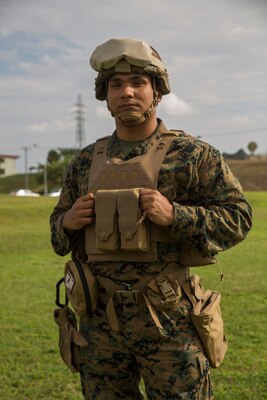
Face of Defense: Okinawa-Based Marine Leads by Example


By Marine Corps Cpl. Bernadette Wildes 31st Marine Expeditionary Unit

CAMP HANSEN, Japan, Jan. 8, 2018 — “I could care less about the awards, the rank, or any of the stuff that I’ve been given,” said Marine Corps Cpl. Noel Mayorqa. “I want to be an example to my squad. That’s what I strive for.”

Mayorqa, a squad leader with Alpha Company, Battalion Landing Team, 1st Marine Battalion, 1st Marine Regiment here, ensures the platoon leader’s intent is being met by making sure each task is done quickly and efficiently. He’s also in charge of accountability, training and the general well-being of his squad. He knows each job within his squad with great detail so he can help guide and shape his squad to perfectly execute the mission.

“I’ve learned everything about being a radio operator from him,” said Lance Cpl. Mason Townsley. “He taught me how to communicate, how to be a better rifleman and how to be a better person.”

Townsley, a radio operator in Mayorqa’s squad, said he doesn’t want to be in any other squad because of Mayorqa’s leadership. “He never lets us slack off,” Townsley said. “He always strives for us to be better, and he’s always pushing to improve himself. It’s really awesome working with someone who is very dedicated to his job.”

Learning Curve

Mayorqa started his career at Marine Barracks Washington, also known as “8th and I” for the intersection near the main gate. The base is home to the Corps’ ceremonial units, and Mayorga said he spent his two years there focused on drilling for ceremonies. He participated in more than 150 standard funerals, 50 full-honors funerals and four different special teams.

“They are really strict on the little things -- the way your uniform looks, the way you drill,” he said. “They always told me that the little things matter. I got a lot of discipline from 8th and I. They also taught me to be confident, respectful and humble.”

Mayorqa said when he checked in with his unit here, he didn’t know anything about being a rifleman. The newer Marines knew more than he did, but that didn’t slow him down. He came to the unit with a positive attitude and ready to learn, said Marine Corps Staff Sgt. Stuart Sanford, the platoon sergeant for 3rd Platoon, Alpha Company.

“He didn’t know everything, but we threw him in a lot of different positions,” Sanford said. “He excelled, and is now one of the best squad leaders in Alpha Company.”

Mayorqa said once he started to learn the information he just wanted more.

“I didn’t do it to stand out with my peer group or be the best,” he said. “I did it because I wanted to know my job and I wanted to share the knowledge that I know. I want to better myself so I can better the Marines to my left and my right.”

Mayorqa said he plans to stay in the Marine Corps as long as he can to continue to push himself and the Marines around him.
“It’s never been about me when it comes to the Marine Corps,” he said. “It was for the brothers to the left and right of me. I wouldn’t be where I am today if it weren’t for my Marines.”

Friday, January 05, 2018

Army Mentors Prepare High Schoolers for Success


By Army Sgt. Christopher Hernandez 345th Mobile Public Affairs Detachment

SAN ANTONIO, Jan. 5, 2018 — On a brightly lit football field inside the Alamodome here, a disparate chorus of clamor and musical instruments reverberates throughout the structure as high school football players and band members practice for the performance of their lives, the 2018

These young men and women train with soldier mentors, elite members of the Army fit to provide professional guidance and inspiration.

Soldier mentors are a prominent feature of All-American Bowl Game Week, an annual event that highlights the nation’s foremost high school football players and marching band teams.

“We do this every year because it’s a great way to put the Army’s message out,” said Army Sgt. 1st Class Brian Waters, a native of Orlando, Florida. “We let the students know that we’re here for them, answer any questions that they have, and lift them up and support them in their future endeavors.”

In addition to attending practices and events throughout the week, the soldier mentors also engage with the players in community service activities for nonprofit organizations and medical centers.

“I’ve seen throughout the years the benefits that the Army gets from these games, as well as for the community of San Antonio,” said Army Staff Sgt. Joseph Lei-Sam, a native of Samoa and the Soldier Mentorship Program manager for the All-American Bowl. “It’s very humbling, and it’s an honor to be here and represent the Army during these games.”

Cultivating Relationships

As the noncommissioned officer in charge of the mentorship program, Lei-Sam oversees all of the soldier mentors and their activities with the students. This includes planning events that cultivate deeper relationships between the soldier mentors and the students.

“For this year, I’ve also implemented new things such as the 7-on-7 flag football game, so we can further build camaraderie between [the soldiers] and the high school football players,” Lei-Sam said.

Lei-Sam and Waters both said a major goal of the Soldier Mentorship Program is to bolster the players’ career aspirations. Lei-Sam said he hopes that these football players end up in the National Football League someday, and that as they progress in their careers, the players will see what the Army is about and how soldiers live up to the Army values.

“It’s a privilege to be here with all of these students,” Waters said. “All of them are future collegiate players potentially going into [colleges with high-level football programs], and they’ve all been very supportive of the military.”

Brandon Brady, a varsity football player and student of Bryon P. Steele II High School in Cibolo, Texas, said this experience is a great opportunity to train alongside soldiers.

“[The soldier mentors] are definitely role models to each and every one of us,” he said. “In just seeing their discipline and the way they do things, it’s going to carry over to us in football and in life. It’s amazing to be able to share this moment with them, play against them, and have some fun.”

The 2018 All-American Bowl will take place at the Alamodome tomorrow, at 1 p.m. EST, and will be televised live by NBC.