by Major George W. Yeakey, U.S. Army, Retired
This article examines the effect of the recently updated U.S. Army Field Manual 22-100, Army Leadership, on situational leadership theory. It reviews the development of adaptive leadership models and theory and considers how refinements in situational leadership theory might affect combat leaders in today's contemporary operating environment.
Adaptive leadership in today's Army is increasingly important with technological changes and the force-structure downsizing that all military services are experiencing. Adaptive leadership is necessary in today's complex and ambiguous military environment. Technology and the availability and flow of information contribute to a very fluid operational situation.1 US Army Field Manual (FM) 22100, Army Leadership, has added transactional and transformational leadership styles of directing, participating, and delegating. These styles add to the leader's arsenal of leadership styles that can be used to shape behavior, emotions, and the organizational climate.
FM 22100 stresses that leaders must be able to adjust their leadership style to the situation as well as to the people being led. Leaders are not limited to one style in a given situation and, with the nature of the battlefield today and tomorrow, being able to adapt appropriate styles will influence soldiers' success. Techniques from different styles are used to motivate people and accomplish the mission. A leader's judgment, intelligence, cultural awareness, and self-control "play major roles in helping you choose the proper style and the appropriate techniques for the task at hand."
Click here to continue reading
Sunday, April 30, 2006


Friday, April 28, 2006
Morale: Whose Job is it anyway?
Karl Von Clausewitz, a Prussian military general and military theorist, identified morale as a fundamental military principle. Since Clausewitz published “On War” morale has developed into a concept seen as critical to organizations, including law enforcement. Unfortunately, morale is difficult to define and in many circles has become somewhat synonymous with motivation. In this article we will look at a very different definition of morale, its potential effects and how the first line supervisor can affect it.
The beatings will continue until morale improves
Often times, people consider morale the same as motivation. But, morale is not about motivation. If it were, negative discipline could improve morale. There are times negative discipline is used to improve performance. Negative consequences can be a powerful tool in shaping behavior. So, if morale were about behavior or performance, negative discipline might be a tool for improving morale.
That is not to say that improved morale does not improve performance; it does. The point is that there is a clear separation between morale and motivation. High morale can be very motivating. High motivation can improve performance. There is a linkage between morale and motivation but they are not he same.
It’s not about individuals
Traditional definitions of morale include: the mood of individuals in the workplace; attitude or spirit; how a unit feels about itself and its abilities; and even, a state of individual psychological well-being. As you can see, these definitions go back and forth between the individual and groups. We all have good and bad days. Yet, as individuals who occasionally wake up on the wrong side of the bed we generally don’t affect the mood of the entire unit. As our personal attitude ebbs and flows, the morale of our unit is marching to a different drummer.
Morale is about groups and it might be defined as how a group feels about what it does. For instance, this group feeling can be an expression of how high or low the group values an activity. If a group of detectives has their job suddenly changed and they find themselves working in uniform and issuing traffic citations they may have lowered morale because they place a low value on working in uniform and issuing citations.
For the detectives, their normal working conditions do not involve uniformed activities nor issuing citations. The activity is outside their group norm and not highly valued. Morale is about sub-group norms and values and their alignment with larger organizational norms and values. For our hapless detectives, working in uniform and issuing citations is not the norm nor highly valued by the group. Therefore, when the larger organization imposes new norms and values, if the group maintains its previous norms and values there is a misalignment which manifests itself as low morale.
Norms, values and morale
Let’s explore how a well delivered “pep talk” before the big game can improve morale. What coaches tell players is that they can win, they are the best, winning is important, etc. During a “pep talk” a coach is not motivating players, rather he or she is reinforcing that the norm is victory and that it is highly valued. The job during a “pep talk” is to align team attitude with the larger organization norms and values. Again, morale is expressed as high or low alignment of norms and values between an organization and its sub-groups.
Of course, if the team doesn’t win it reverts to the norm of a losing and is out of alignment with the larger norm. The team’s morale is lower after the loss. Conversely, a win could serve to reinforce the team belief in the norm and value of victory. After a win, we would expect high morale.
A norm is the behaviors expected within a group of individuals. It is a belief shared by the group about what is normal and acceptable. In groups we establish norms so that we can anticipate and judge the actions of other group members. In law enforcement we have a strong safety norm. We expect our peers to be tactically sound and safe. We place a high value on this norm. Value is an expression of worth we place on an activity. In other words, groups can have many norms (safety and productivity) and they can place differing values on those norms. For instance, we generally value safety over productivity.
Changes from the top, within and outside
If your organization developed a new rule, policy or procedure that seemed to value productivity over safety morale would be lower. Employees would have the previous value scheme wherein safety was more important than productivity. They would not feel good about the change. Also, like the detectives who were asked to issue citations, if the organization rapidly changes the norm, employee morale falls. It is the imposed change in the value or norm that lowered morale.
Changes and challenges to sub-group norms sometimes come from outside the organization. If a police officer is killed, especially in the line-of-duty, many group norms and values are challenged. Daily, police officers face dangerous situations. The norm is that we, as individuals or members of a team overcome those dangers. The death can represent an inability to overcome danger thereby challenging the norm. Moreover, we value human life, the individual person who died and safety. An on-duty death can shake all three values. This outside challenge to the norm can lead to a lowering of morale.
Sub-group changes from within are somewhat more subtle. A sub-group with high congruence to organizational values can find itself drifting towards new sub-group norms and values and experience lowered morale. As an example, weak small-unit leadership can lead to deviant peer group behavior becoming the norm. Perhaps the leader allows a clique to grow within a watch. A clique will develop its own norms and values. Typically, it will value clique membership more than watch membership. This change in values leads to a change in normal behavior which manifests itself as a reduction in watch morale.
Alignment is more than motivation
When groups feel good about what they do, they experience high morale. Certainly, high morale can lead to improved productivity and quality. If we accept the proposition that morale is an expression of sub-group alignment with larger organizational norms and values an increase in productivity and quality makes sense. As an example, if the sub-group and the larger organization both value traffic citations, traffic citations will be issued.
For law enforcement, sub-group alignment with larger organizational norms and values is even more critical. Police officers work in a high discretionary environment. Basically, we choose when to intervene and what to do. The use of discretion is driven by our norms and values. In other words, our decisions will reflect our alignment with organizational norms and values. Consider the impact of norms and values alignment on high discretionary activities like the application of reasonable suspicion, probable cause, use of force, and vehicle pursuits. Simply put, high morale leads to greater group and individual integrity.
How small-unit leadership impact morale
Because morale is an expression of how well your unit has incorporated organizational norms and values morale is critical part of your leadership. First, you should seek clarity in understanding your organization’s norms and values. You should understand how your organization’s mission, goals or objectives support the norms and values. After it is clear to you, express it to your unit. Use your roll call time to incorporate a discussion on norms and values.
To lead a small unit you must be a story-teller. When you train or debrief during roll call emphasize how actions reflected your organization’s norms and values. Be specific. Every action can be interpreted through your organization’s norms and values. Let your people know specifically how their actions reflect positively or negatively on the overall norms and values.
The next time your offer praise consider that you are not praising the action so much as praising how much the action reflects the norms and values. In law enforcement, your unit is performing much of its critical work without the benefit of your on scene leadership. The only way you can influence them at critical moments is by reinforcing their understanding and commitment to your organization’s norms and values. It must be in their heart and only you can put it there.
You don’t have any control over outside influences. You are going to face the implementation of an unpopular change in the norm. Somebody is going to dictate a new policy or procedure. While you can’t control the outside influence you can control your unit’s interpretation of it. Minor changes are fairly simply. Introduce the new policy or procedure, provide your employees with as much background on why the change is necessary, train them and then follow-up with praise or sanction. Larger or dramatic changes are more difficult.
As with smaller changes to the norm, you must first seek clarity. Find out as much as you can why the change is necessary. Make sure you know as much as possible. I am always honest with my people. When I don’t like something or think a change is going to be difficult I admit it. As a follower, I have sat through too many gratuitous roll calls where the sergeant or lieutenant is giving us happy talk. I recommend you say something like, “I don’t like this anymore than you do. But, this is how we are going to do it.”
This admission is actually an emphasis of the norm of obedience to orders and the value of you place on it. After you have made this admission, adopt the new norm and place the appropriate value on it. Don’t undermine yourself or your organization by rolling your eyes or somehow expressing that you don’t believe the new change should be implemented. As with the minor change, provide your employees with background information, training and follow through.
It is very likely that by addressing difficult issues head on you will improve morale. Your leadership is a reflection on your ability to maintain alignment between your unit and the larger organization. By praising actions as an expression of organizational norms and values you will be providing your employees with leadership during whatever situation they face. Morale is your job.
About the Author
Lieutenant Raymond E. Foster retired from the Los Angeles Police Department after 24 years of service. He is the author of “Police Technology (Prentice Hall, July 2004) and number articles on technology, leadership, terrorism and policing. Raymond is a part-time lecture at California State University, Fullerton and a part-time faculty advisor at the Union Institute and University. He has three current book projects. They are on terrorism, policing and leadership.
The beatings will continue until morale improves
Often times, people consider morale the same as motivation. But, morale is not about motivation. If it were, negative discipline could improve morale. There are times negative discipline is used to improve performance. Negative consequences can be a powerful tool in shaping behavior. So, if morale were about behavior or performance, negative discipline might be a tool for improving morale.
That is not to say that improved morale does not improve performance; it does. The point is that there is a clear separation between morale and motivation. High morale can be very motivating. High motivation can improve performance. There is a linkage between morale and motivation but they are not he same.
It’s not about individuals
Traditional definitions of morale include: the mood of individuals in the workplace; attitude or spirit; how a unit feels about itself and its abilities; and even, a state of individual psychological well-being. As you can see, these definitions go back and forth between the individual and groups. We all have good and bad days. Yet, as individuals who occasionally wake up on the wrong side of the bed we generally don’t affect the mood of the entire unit. As our personal attitude ebbs and flows, the morale of our unit is marching to a different drummer.
Morale is about groups and it might be defined as how a group feels about what it does. For instance, this group feeling can be an expression of how high or low the group values an activity. If a group of detectives has their job suddenly changed and they find themselves working in uniform and issuing traffic citations they may have lowered morale because they place a low value on working in uniform and issuing citations.
For the detectives, their normal working conditions do not involve uniformed activities nor issuing citations. The activity is outside their group norm and not highly valued. Morale is about sub-group norms and values and their alignment with larger organizational norms and values. For our hapless detectives, working in uniform and issuing citations is not the norm nor highly valued by the group. Therefore, when the larger organization imposes new norms and values, if the group maintains its previous norms and values there is a misalignment which manifests itself as low morale.
Norms, values and morale
Let’s explore how a well delivered “pep talk” before the big game can improve morale. What coaches tell players is that they can win, they are the best, winning is important, etc. During a “pep talk” a coach is not motivating players, rather he or she is reinforcing that the norm is victory and that it is highly valued. The job during a “pep talk” is to align team attitude with the larger organization norms and values. Again, morale is expressed as high or low alignment of norms and values between an organization and its sub-groups.
Of course, if the team doesn’t win it reverts to the norm of a losing and is out of alignment with the larger norm. The team’s morale is lower after the loss. Conversely, a win could serve to reinforce the team belief in the norm and value of victory. After a win, we would expect high morale.
A norm is the behaviors expected within a group of individuals. It is a belief shared by the group about what is normal and acceptable. In groups we establish norms so that we can anticipate and judge the actions of other group members. In law enforcement we have a strong safety norm. We expect our peers to be tactically sound and safe. We place a high value on this norm. Value is an expression of worth we place on an activity. In other words, groups can have many norms (safety and productivity) and they can place differing values on those norms. For instance, we generally value safety over productivity.
Changes from the top, within and outside
If your organization developed a new rule, policy or procedure that seemed to value productivity over safety morale would be lower. Employees would have the previous value scheme wherein safety was more important than productivity. They would not feel good about the change. Also, like the detectives who were asked to issue citations, if the organization rapidly changes the norm, employee morale falls. It is the imposed change in the value or norm that lowered morale.
Changes and challenges to sub-group norms sometimes come from outside the organization. If a police officer is killed, especially in the line-of-duty, many group norms and values are challenged. Daily, police officers face dangerous situations. The norm is that we, as individuals or members of a team overcome those dangers. The death can represent an inability to overcome danger thereby challenging the norm. Moreover, we value human life, the individual person who died and safety. An on-duty death can shake all three values. This outside challenge to the norm can lead to a lowering of morale.
Sub-group changes from within are somewhat more subtle. A sub-group with high congruence to organizational values can find itself drifting towards new sub-group norms and values and experience lowered morale. As an example, weak small-unit leadership can lead to deviant peer group behavior becoming the norm. Perhaps the leader allows a clique to grow within a watch. A clique will develop its own norms and values. Typically, it will value clique membership more than watch membership. This change in values leads to a change in normal behavior which manifests itself as a reduction in watch morale.
Alignment is more than motivation
When groups feel good about what they do, they experience high morale. Certainly, high morale can lead to improved productivity and quality. If we accept the proposition that morale is an expression of sub-group alignment with larger organizational norms and values an increase in productivity and quality makes sense. As an example, if the sub-group and the larger organization both value traffic citations, traffic citations will be issued.
For law enforcement, sub-group alignment with larger organizational norms and values is even more critical. Police officers work in a high discretionary environment. Basically, we choose when to intervene and what to do. The use of discretion is driven by our norms and values. In other words, our decisions will reflect our alignment with organizational norms and values. Consider the impact of norms and values alignment on high discretionary activities like the application of reasonable suspicion, probable cause, use of force, and vehicle pursuits. Simply put, high morale leads to greater group and individual integrity.
How small-unit leadership impact morale
Because morale is an expression of how well your unit has incorporated organizational norms and values morale is critical part of your leadership. First, you should seek clarity in understanding your organization’s norms and values. You should understand how your organization’s mission, goals or objectives support the norms and values. After it is clear to you, express it to your unit. Use your roll call time to incorporate a discussion on norms and values.
To lead a small unit you must be a story-teller. When you train or debrief during roll call emphasize how actions reflected your organization’s norms and values. Be specific. Every action can be interpreted through your organization’s norms and values. Let your people know specifically how their actions reflect positively or negatively on the overall norms and values.
The next time your offer praise consider that you are not praising the action so much as praising how much the action reflects the norms and values. In law enforcement, your unit is performing much of its critical work without the benefit of your on scene leadership. The only way you can influence them at critical moments is by reinforcing their understanding and commitment to your organization’s norms and values. It must be in their heart and only you can put it there.
You don’t have any control over outside influences. You are going to face the implementation of an unpopular change in the norm. Somebody is going to dictate a new policy or procedure. While you can’t control the outside influence you can control your unit’s interpretation of it. Minor changes are fairly simply. Introduce the new policy or procedure, provide your employees with as much background on why the change is necessary, train them and then follow-up with praise or sanction. Larger or dramatic changes are more difficult.
As with smaller changes to the norm, you must first seek clarity. Find out as much as you can why the change is necessary. Make sure you know as much as possible. I am always honest with my people. When I don’t like something or think a change is going to be difficult I admit it. As a follower, I have sat through too many gratuitous roll calls where the sergeant or lieutenant is giving us happy talk. I recommend you say something like, “I don’t like this anymore than you do. But, this is how we are going to do it.”
This admission is actually an emphasis of the norm of obedience to orders and the value of you place on it. After you have made this admission, adopt the new norm and place the appropriate value on it. Don’t undermine yourself or your organization by rolling your eyes or somehow expressing that you don’t believe the new change should be implemented. As with the minor change, provide your employees with background information, training and follow through.
It is very likely that by addressing difficult issues head on you will improve morale. Your leadership is a reflection on your ability to maintain alignment between your unit and the larger organization. By praising actions as an expression of organizational norms and values you will be providing your employees with leadership during whatever situation they face. Morale is your job.
About the Author
Lieutenant Raymond E. Foster retired from the Los Angeles Police Department after 24 years of service. He is the author of “Police Technology (Prentice Hall, July 2004) and number articles on technology, leadership, terrorism and policing. Raymond is a part-time lecture at California State University, Fullerton and a part-time faculty advisor at the Union Institute and University. He has three current book projects. They are on terrorism, policing and leadership.
Leadership in Action
Every student of leadership has read about the great military leaders of the past. Everyone knows of Patton, Bradley, Marshall, MacArthur and Eisenhower. Clearly, these leaders provided stellar examples for us to follow, but its leadership at every level of the organization that separates the merely good from the great. In great organizations effective leadership is practiced everyday, by every member.
Although twenty years old, the United States Army “Leadership in Action” book provides nearly fifty leadership success stories from every rank, including civilian. The short vignettes, from “The Hanger Queen” to the “Doing More with Less….and Liking it” provide interesting and salient leadership stories and advice. Moreover, the stories are examined in the light of different leadership challenges and solutions. There is tons of practical advice for use in any organization.
These case studies, presented in interesting narrative form, provide the depth necessary for personal leadership development.
A complete copy is available free at the Armed Forces Reading List
Although twenty years old, the United States Army “Leadership in Action” book provides nearly fifty leadership success stories from every rank, including civilian. The short vignettes, from “The Hanger Queen” to the “Doing More with Less….and Liking it” provide interesting and salient leadership stories and advice. Moreover, the stories are examined in the light of different leadership challenges and solutions. There is tons of practical advice for use in any organization.
These case studies, presented in interesting narrative form, provide the depth necessary for personal leadership development.
A complete copy is available free at the Armed Forces Reading List
Jump Start your Leadership
The Use of Power
It’s your first day in your assignment. Perhaps you are a newly appointed leader, or you have been transferred into a new assignment. How do you establish leadership? How do you get things moving in the right direction? You have the positional authority, the stripes or bars or whatever symbol of leadership. The position is only one type of leadership power and for the most part the weakest.
It’s your first day in your assignment. Perhaps you are a newly appointed leader, or you have been transferred into a new assignment. How do you establish leadership? How do you get things moving in the right direction? You have the positional authority, the stripes or bars or whatever symbol of leadership. The position is only one type of leadership power and for the most part the weakest.
As you study your craft, leadership, you will find that there are several types of leader power. Many people have a difficult time with the word “power;” It can carry negative connotations. Recall our first article and think of our definition of leadership – “The art of influencing human behavior toward organizational goals.” In the leader realm, power is the amount and type of influence the leader possesses. First, let’s define four of the power bases you can work from as a new leader and then we will explore how to combine them into a plan to “jump start” your leadership.
- Compensatory Power - The ability to reward team members. Rewards can be praise, cash, a corner office, a title, control over schedule and priorities, recommendations, choice of the next assignment, promotion, or any number of things. In the police service, compensatory rewards are usually recognition and special assignments.
- Expert Power – Knowing the task, especially when you know the task better than the subordinate.
- Referent Power – Respect of your subordinates. Usually developed when you have a track record of making successful decisions and you develop bonds with your subordinates.
- Positional Power – Authority based solely on your job description.
There are several other types of leader power, but for a “jump start” we are going to combine position, compensatory, expert and referent types. Your “jump start” strategy begins by establishing a training program within your new unit. We are not talking about a formal training program. You are going to use a short period of time during briefings and in the field to combine these four types of power into a leadership jump start.
Teach to Lead
Consider that from the Kindergarten through your senior year in high school you were programmed by the state to respect the teacher as the leader. A teacher combines the four powers to influence your behavior. Indeed, next time you attend a training seminar watch how people react to the teacher. Even the “hardcore” eventually sit down and display respect. They listen and often learn. Teaching is perhaps the simplest way to combine multiple powerbases and jump start your leadership.
Begin by observing your unit as they work through field problems. For instance, imagine one of your units becomes involved in a somewhat complex felony arrest. What you are looking for are incidents wherein your officers did an outstanding job. You don’t need to be present; you can see their good work from their arrest reports or comments from their peers. During the next briefing, recognize them by asking them to tell the assembly about the incident. At first, concentrate these briefings on the officers simply telling their peers about the incident. Get them to emphasize their success and share their talent. Compliment them and follow-up on their presentation by adding your own positive comments. After you have done five or six of these, change the “de-briefings” slightly by having the officer present their incident and then ask them, “Is there anything you would have done differently?” You are beginning to lead them toward “de-briefing” their work through self-critique. Keep these “de-briefings” positive.
Clues from their De-Briefing
The officers’ own comments on what they would have done differently are the keys to initial training. Tailor ten or fifteen-minute lesson plans based on their comments. For example, if in debriefing an incident, your officers identify searching techniques as something they would have done differently, you have a training subject. Within two or three days, while the debriefing is still fresh, hold your training. You can hold the training in regular briefing, or alternatively, have one or two units meet you and go over the training in the field.
In addition to their comments, begin to note what you think they should be doing differently. As your training progresses, add your skills, knowledge and observation to the training sessions. After a few weeks, you should change the de-briefs again by asking the assembly to critique the officers. What do their peers think? What would they have done differently? As your de-briefings progress, introduce tactical blunders from outside your agency; outside your state if possible. Make the discussions as impersonal by removing the possibility that anyone present could have been involved. Outline the incident and then ask your unit, What could have been done differently?” By following this formula it will take you about six weeks to get to the point where you can lead your unit through frank discussions about the their own capers, especially the ones that went side-ways.
Different Versus Wrong
Things can always be done differently. In police work there are often no right or wrong solutions to problems. Moreover, people will become defensive when you tell them they were wrong. Most people can tolerate thoughts on how to do something differently. The critical point is to keep the discussions positive by using positive words and phrases.
Emphasis Safety
You should consider almost always approaching any training from the standpoint of safety. That’s right – all training should have a safety component. According to a recent RAND study, “the historical injury and fatality rates for police and career firefighters are approximately three times greater than the average for all professions, and place these careers in the top 15 occupations for risk of fatal occupational injury[i].” Obviously, police work is dangerous, so any training that emphasizes safety is good training.
Police work develops a strong safety orientated sub-culture. Because we rely on each other for our personal safety, we reward and sanction behaviors that increase our personal safety. This is one explanation for the “code of silence.” You are simply less likely to expose a peer to administrative disapproval when you depend on that peer for your personal safety. Personal safety may be the strongest motivating factor in changing police behavior. If it is not the strongest, it is at the top. You can teach any subject with a safety component. You need only be creative to teach ethics, community policing, anger management or dispute resolution skills through the lens of personal safety. When you do, your officers will listen and follow.
Identifying Training Needs
There are no high-speed, low-drag, Teflon-coated tactics that will save a street cop’s life; there are only the basics. Read the Federal Bureau of Investigation’s summary on police officers killed in the line of duty. The basics (like searching and weapons retention) are continually among the top elements of police officer fatalities. As your officers identify training needs through their de-briefings you should be looking for common threads. You will see the same issues over and over.
Begin to keep a notebook on your training issues. This will help you refine lesson plans throughout your career. After ten years as a sergeant, I had 125, one-page lesson plans in four binders. Every time I changed assignments or shifts I went back to page one and began to work through the book – updating as I taught the subjects.
In addition to “jump starting” your leadership role, you are also improving unit performance. At some point you are going to begin to turn the training components over to senior unit members. There is nothing better than a watch, or unit, that is so well run the leader need only identify which peer-group leader will be conducting the training. Part Three will look further at the development of peer group leaders.
[i] Latourrette, Tom, D. J. Peterson, James T. Bartis, Brian A. Jackson, and Ari Houser. Protecting Emergency Responders / . Santa Monica, CA: Rand, 2003
Leadership: Texas Hold 'em Style
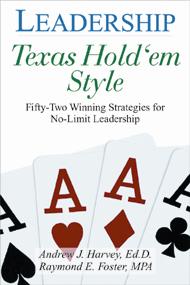
Using poker as analogy for leadership, Captain Andrew Harvey, CPD (ret.), PhD and Lieutenant Raymond E. Foster, LAPD (ret.), MPA found the right mix of practical experience and academic credentials to write a definitive book for leaders. Most often leaders find they are given a set of resources – people, equipment, funds, experience and mission. As Foster noted, “You are dealt a certain hand. And, how you play that hand as a leader determines your success.”
Visit their website.
Navy Leadership Continuum
The Navy Leadership Continuum is a career-long continuum of Navy leader development, from recruitment to retirement. A total of eight Leadership Training Courses for officer and enlisted personnel have been developed to form the cornerstone of that continuum. These progressive and sequential courses are all two weeks with the exception of the nine-week senior enlisted academy. Four major themes are the foundation of all the courses: values; responsibility, authority, and accountability of leadership; unity of command, Navy and services and risk management/ continuous improvement. The formal leadership training will be periodically reinforced with "booster shots" in warfare/specialty pipeline training, at annual all hands training, and during development/ professional assignments. Current education and training programs that include leadership modules are being brought into alignment with the continuum themes to ensure consistency and eliminate redundant or conflicting training.
Click here to Read on
Click here to Read on
Small Unit Leadership
This series of articles is about small unit leadership. Not leadership in a wider organization sense, but leadership down in the weeds. We will be looking at the kind of leadership necessary for employees involved in highly complex problem-solving tasks (tactical situations to interpersonal communication skills). The primary focus is for those leaders practicing their trade with street cops, small vice or narcotic units, or tactical teams.
Our first step will be to work out a definition of leadership. As we progress through this series of articles we will explore how leadership skills can be gained, honed and applied.
Nearly every promotional interview panel asks some type of leadership questions. Indeed, they often simply ask the interviewee to define leadership. Ask someone. They will probably work backwards and use the words lead and leader to define leadership. But, a working definition of the word is critical before we can apply the concepts to small units.
For our purposes leadership is defined as “The art of influencing human behavior toward organizational goals.” Leadership is an art. But, like all art it has its underpinnings in science. Think of a painter. Inside of the painter’s mind the picture is waiting to be expressed. But, the painter must know the science – which brush strokes will attain a certain effect, which colors blend to create the desired color, how is depth obtained, and so on. The art is the interpretative application of the science. For leadership there are a variety of model and theories with which the leader can draw upon. But, to practice his or her art, the leader must know the science.
Influencing best describes the all encompassing behaviors a leader might use. For instance, during a tactical situation wherein the leader behavior is likely to be highly directive, the leader influences by giving orders. At other times, when employees are involved in completing tasks outside the direct observations of the leader, influence may come in the form of prior training, counseling or direction. Our point is that to influence the leader does not need to be present during the completion of the task.
Leadership is about human behavior. For small unit leaders there are two underlying concepts about human beings. First, you can not always predict what a human being is going to do. Certainly, you can make accurate generalizations. But, you cannot know with any degree of certainty how every human will react or act. There are too many variables, too many unknowns. Second, you cannot change people. That’s a newsflash to many! After a certain age (and anyone in our small units has certainly passed the age), people do not change. Now, their may be a pilot light inside of them waiting for a spark. But, if there is no gas running to the pilot light all the fire in the world is useless. A leader must accept that all they can do is modify a human being’s behavior. The key concept is that the leadership task is about working with and influencing human behavior.
In small units, leadership is not about attainment, it is about movement. This is a key concept and the reason the word “toward” appears in our definition. Strategic goals, unit goals, unit membership and the environment are constantly changing. Leadership is a full-time, continuous occupation. Its about preparing for the next tactical incident, inculcating the newest member, attaining the latest measurable goal. It is constant, moving, fluid and dynamic. It is toward.
Your small unit was created by the organization to accomplish some goal. It is critical for the leader to remain focused on the organizational goals, not the leader’s goals. Too many small units pursue the leader’s goals and not the organizational goals. A great leader is always focused on the organizational goals. Some are asking – but what about competing concerns.
So, leadership is the art of influencing human behavior toward organizational goals.
Before you rattle off about “being a company man,” re-read the definition and the explanations. Human beings are in the center of our definition. There is no organization without the people who need it or the people who comprise it. Our central theme throughout this series is going to be - how does the leader balance the needs of the follower, the organization and in policing, the community?
Our first step will be to work out a definition of leadership. As we progress through this series of articles we will explore how leadership skills can be gained, honed and applied.
Nearly every promotional interview panel asks some type of leadership questions. Indeed, they often simply ask the interviewee to define leadership. Ask someone. They will probably work backwards and use the words lead and leader to define leadership. But, a working definition of the word is critical before we can apply the concepts to small units.
For our purposes leadership is defined as “The art of influencing human behavior toward organizational goals.” Leadership is an art. But, like all art it has its underpinnings in science. Think of a painter. Inside of the painter’s mind the picture is waiting to be expressed. But, the painter must know the science – which brush strokes will attain a certain effect, which colors blend to create the desired color, how is depth obtained, and so on. The art is the interpretative application of the science. For leadership there are a variety of model and theories with which the leader can draw upon. But, to practice his or her art, the leader must know the science.
Influencing best describes the all encompassing behaviors a leader might use. For instance, during a tactical situation wherein the leader behavior is likely to be highly directive, the leader influences by giving orders. At other times, when employees are involved in completing tasks outside the direct observations of the leader, influence may come in the form of prior training, counseling or direction. Our point is that to influence the leader does not need to be present during the completion of the task.
Leadership is about human behavior. For small unit leaders there are two underlying concepts about human beings. First, you can not always predict what a human being is going to do. Certainly, you can make accurate generalizations. But, you cannot know with any degree of certainty how every human will react or act. There are too many variables, too many unknowns. Second, you cannot change people. That’s a newsflash to many! After a certain age (and anyone in our small units has certainly passed the age), people do not change. Now, their may be a pilot light inside of them waiting for a spark. But, if there is no gas running to the pilot light all the fire in the world is useless. A leader must accept that all they can do is modify a human being’s behavior. The key concept is that the leadership task is about working with and influencing human behavior.
In small units, leadership is not about attainment, it is about movement. This is a key concept and the reason the word “toward” appears in our definition. Strategic goals, unit goals, unit membership and the environment are constantly changing. Leadership is a full-time, continuous occupation. Its about preparing for the next tactical incident, inculcating the newest member, attaining the latest measurable goal. It is constant, moving, fluid and dynamic. It is toward.
Your small unit was created by the organization to accomplish some goal. It is critical for the leader to remain focused on the organizational goals, not the leader’s goals. Too many small units pursue the leader’s goals and not the organizational goals. A great leader is always focused on the organizational goals. Some are asking – but what about competing concerns.
So, leadership is the art of influencing human behavior toward organizational goals.
Before you rattle off about “being a company man,” re-read the definition and the explanations. Human beings are in the center of our definition. There is no organization without the people who need it or the people who comprise it. Our central theme throughout this series is going to be - how does the leader balance the needs of the follower, the organization and in policing, the community?
Subscribe to:
Posts (Atom)


 Posts
Posts

